OSCAR NOMINEE VIOLA DAVIS

  • Subscribe to our RSS feed.
  • Twitter
  • StumbleUpon
  • Reddit
  • Facebook
  • Digg

Tuesday, 1 January 2013

Patricia Clarkson: The Hollywood Interview

Posted on 17:03 by Ratan
Actress Patricia Clarkson.


PATRICIA CLARKSON: BELLE OF THE BALL
By
Alex Simon


Editor’s Note: This article appears in the March 2008 issue of Venice Magazine.


Patricia Clarkson should be designated a national treasure. One of America’s finest actors, she first appeared on movie screens (and made many man’s heart-a-flutter) in Brian de Palma’s The Untouchables (1987), playing the wholesome wife of Kevin Costner’s intrepid G-man Eliot Ness. Since that time, Patricia Clarkson has appeared in over 60 roles in TV and feature films, playing everything from suburban housewives to drug-addled lesbian actresses. The diversity in her body of work betrays a talent that seems to grow and evolve with each passing year, a rare mark that only the real mccoys of the artistic community can boast to bear.

Born and raised in the Big Easy AKA New Orleans, LA., this southern belle made her debut on the world stage December 29, 1959, the fifth child (and fifth daughter) of a father who ran the Louisiana State University Medical School and a mother who would go to onto become a renowned city councilwoman. After graduating Yale University’s prestigious drama program, Patricia never stopped working, initially trodding the boards on the New York stage, and soon landing plum supporting roles on television shows such as The Equalizer and Spencer: For Hire.

After making her feature debut, just a few of the noteworthy cinematic turns Patricia made include Rocket Gibraltar, Everybody’s All-American, The Dead Pool, Tune in Tomorrow, Pharaoh’s Army, Jumanji, High Art, Playing by Heart, The Green Mile, The Pledge, Wendigo, The Safety of Objects, Far From Heaven, Dogville, Miracle, The Dying Gaul, The Station Agent and last year’s sleeper hit, Lars and the Real Girl.

2003’s Pieces of April nabbed Patricia many much-deserved kudos, including: An Academy Award nomination as Best Supporting Actress, and best supporting wins from The Boston Society of Film Critics Award, The Chicago Association of Film Critics Award, The National Board of Review, and a special jury prize from Sundance, which was also given for her work in that year’s The Station Agent and All the Real Girls. Patricia also won two Emmy Awards for her recurring role on the HBO hit Six Feet Under, as well as an acting prize from the Deauville Film Festival for The Safety of Objects, and the New York Film Critics Circle Award for her work in Far From Heaven.

2008 has also proven to be a busy year for the lovely Miss Clarkson: Married Life, from Sony Pictures Classics, features Patti as a housewife circa 1948 whose seemingly idyllic marriage to successful corporate exec Chris Cooper is not all that it seems. Pierce Brosnan and Rachel McAdams round out the cast of this fine drama from co-writer/director Ira Sachs, which is punctuated with bursts of black humor and satire. Patti also just wrapped Woody Allen’s latest, Vicky Cristina Barcelona, Isabel Coixet’s Elegy, and will start work on Martin Scorsese’s latest effort, Shutter Island, this summer. Patricia Clarkson sat down with Venice recently to discuss her latest work, her remarkable past accomplishments, and her pride in being a New Orleanian.


After seeing Married Life I thought immediately what a great double bill it would make with Far From Heaven.
Patricia Clarkson: (laughs) Yeah, that’s true. They’re very different films, but they’re both period pieces about secrets and intrigue and marriage.

I thought it was very Bergmanesque in the way it examined relationships.
It’s so funny you bring that up, because there is great humor in many of the scenes. We were just in the Miami Film Festival and the audience was just rolling in the aisles during some scenes laughing, and gasping in others. But when Chris and I were actually shooting a lot of these scenes, we went for broke, and it was like Ingmar Bergman. So although people might be laughing at certain points, these are very, very intense scenes and in order for them to have any kind of pay-off, we had to play everything completely straight. We were as invested as any deeply dramatic film I’ve ever done.

I think it was probably nervous laughter you were hearing.
(laughs) Well, yes!

Patricia Clarkson in Married Life.

I thought it was such a brilliant metaphor with the cast playing charades at the end.
Yes, and then putting the house back together.

Tell us about working so closely with Chris Cooper.
He’s an incredible man, very bright. He’s a real man. Everything you would want him to be, he is. Sometimes you meet or work with a star, and they disappoint. He doesn’t: he’s a gentleman. He has crazy talent. We actually worked together years ago in a film called Pharaoh’s Army (1995). It’s a tiny, little Civil War film where Chris plays a Union soldier and I’m a confederate woman on a farm whose husband is off at war. Chris and his men come and basically take over my farm. It’s this kind of chaste, dark love story in a way between me and Chris. It was actually the very first independent movie I ever did, before High Art. So we’ve been friends for years, and I’m friends with his wife, so that made doing this film with him very easy, because I was able to build on the intimacy of our friendship that was already there. Because you can only act so much, as an actor. There has to be some kind of connection there. He’s very giving, very selfless, which is rare.

Clarkson and Chris Cooper in Married Life.

It was great to see Pierce Brosnan on-screen again. He’s like this generation’s Cary Grant.
Yes, he’s got all the talent and all the charm. He’s timeless and effortless and…how much more thrilled could I be that I’ve got Chris Cooper as my husband and Pierce Brosnan as my confidante! Pierce is a real gentleman, too.

You’re a southern belle, born and raised in New Orleans. You’ve also played some great repressed women, all of whom could have easily slipped into caricature but you made them very real. Being from the south did you grow up around a lot of these types of women?
Well Pat is not repressed, so to speak, she’s secretive. I think Pat, for a period woman, without revealing her secret, is quite a sexual, sensual modern woman. She’s trapped by the times, but the era might repress her, but I don’t think Pat is a truly repressed woman. I think she’s a woman that has to adhere to the constraints that are placed upon her. I think if she’d been born ten years later, she’d have had a very different life. I think would have had a career, and lovers, and…a fast car! (laughs) And lots of lipstick! (laughs) So there was a certain repression to women of eras gone by that we associate with period films, but if you think about what she says at the get-go, that love is sex, many people still find it shocking now that I say that!

That’s too bad.
(both laugh) Yes, it is.

L to R: Patricia Clarkson, co-writer/director Ira Sachs and Chris Cooper confer on the set of Married Life.

But you had a very dynamic, working mother growing up, so that had to have had an influence on you.
Oh, absolutely, but she didn’t go to work until we were a little older.

How many siblings do you have?
Four older sisters, and we’re all eighteen months apart.

Wow…all that hot southern blood in one house! Dad had to have at least one shotgun loaded at all times.
Oh, I think he had several! (laughs) But we were like his harem. My father is a remarkable man. He’s a very kind, gentle soul, and is very witty. He’s one of the funniest people I’ve ever known. He started out running a children’s home when we were little, then got a PhD in Public Health, and ran the LSU Medical School Department of Medicine. He wasn’t a doctor. He was an administrator. But he’s retired now and lived in a house of six women and two female dogs. I mean…but I think he kind of loved it! (laughs) He has male grandchildren now, so the estrogen count that he had to live with has petered out somewhat.

Do you and your sisters all look alike?
We all have similar timbres to our voices and similar mannerisms, so you know when you see us together that we’re sisters. I look like my mother, especially in this movie. In the poster for the movie, oh my God! (laughs) My sisters are all very accomplished and have beautiful lives. My oldest sister isn’t married, but my middle sisters all mix family and marriage and very challenging careers.

Did they all stay in the South?
Yes, they all stayed in the New Orleans area except for one, who lives in Dallas.

So you’re the only defector then who not only defected, but went to that ultimate Yankee state, New York.
Yes, when I was 19. I transferred from LSU to Fordham University’s College at Lincoln Center. My parents were…it was difficult for southern parents to let their daughter go off by herself to New York City. They agreed to let me go to New York if I finished my bachelor’s degree. So it was a real stretch for my parents, putting their fifth child through school, and they weren’t rich by any means. We were middle, or upper-middle class, but New York has always been incredibly expensive. So the sacrifices they made to send me there were enormous.

They must’ve seen something in you early on.
My mother especially knew that I was serious about being an actress.

When did you know you were an actress?
Probably when I was 13.

What happened?
I gave a speech in speech class, and my teacher said “You know, I think you’re an actress. You should join the drama department.” And I did! And that was it. I did a play called F.L.I.P.P.E.D.: Feminist Liberation Idealist Party for Permanent Equality and Democracy. The drama teacher was a major feminist. It was 1974 or ’75 and we did this rockin’ play! I had great training in New Orleans and great mentors, believe it or not. So I went to Fordham and had an amazing mentor there named Joe Jezewski, and then I got into Yale. I went right from Fordham into graduate school there. It was a fantastic, and rigorous experience. I mean, it was eighteen hour days. But in so many ways I didn’t realize at the time, it prepared me so much for this business, and not in the sense of auditioning and “the business,” but in a chemical, physiological way because it required so much of you. Then I graduated in ’85 and lived in New York.

The first thing I remember seeing you in was when you played the butt-kickin’ bride on that great episode of The Equalizer.
(laughs) Oh my God! I have to tell you, I did The Untouchables before I did The Equalizer, and I also did a Spencer: for Hire. (laughs)

Oh my God, it’s ‘80s night!
(laughs) Right? I played a murderer on that one. Foreshadowing. (both laugh)

But I imagine having a film like The Untouchables be your first feature must’ve been an amazing experience.
It was! Working with Brian de Palma first out of the gate was a great education. Again, it was illuminating and it was real on-the-job training.

Clarkson and Kevin Costner in The Untouchables (1987), her film debut.

It must’ve been especially tough with your stage background because, if memory serves, de Palma shot you almost entirely in extreme close-up.
Yes. I couldn’t touch a cup of coffee during that shoot! (laughs) But Brian really helped. You never forget your first, and he really took me under his wing. We keep in touch still. We’re friends, and I adore him. He has a great, wicked sense of humor.

You did about 2-3 years of stage work before your film career really took off, right?
Right. I was doing a lot of off-Broadway and Broadway. It was a dream, just beautiful shows, like The House of Blue Leaves. I met John Guare, and Richard Greenberg, and Nicky Silver. I was lucky and had great fortune to do this wide variety of parts on stage and then slowly doing these films like Rocket Gibraltar and Everybody’s All-American, which took place in Louisiana, but I played the Yankee! (laughs) And then I did The Dead Pool. Then things were cool for me for a while, while I was in my early ‘30s, and that was an interesting time for me.

That’s a tough age for actresses. It’s like the old saying about the three stages in an actress’ life: babe, district attorney, and Driving Miss Daisy.
(laughs) Yes, it’s so true!

You mentioned The Dead Pool. Tell us about the great Clint Eastwood.
I had just done Everybody’s All-American, and flew to San Francisco and met him for the first time. There were women screaming outside the restaurant, and just about everywhere we went: just mobs of people. He’s such a movie star. Working with George Clooney down the line was quite similar: just the sheer power they have with people. But at the same time, they’re both very real, and approachable and first-class people. But being the female lead in the final Dirty Harry movie was amazing! You know that Clint is famous for doing one take, right? So here I am on maybe my third movie, this huge part with lots of dialogue, playing an anchorwoman rattling off all this dialogue, paragraphs worth, and Clint would be looking at me and would say “That was good for me. Was it good for you?” I’d say ‘Uh yeah, sure!’ “Movin’ on!” (laughs) He was cutting Bird at the time, and was really burning the candle at both ends, and was still just unflappable. I’m very grateful that part of my “lore,” so to speak, will be that I worked with Clint Eastwood.

When you look at your career, it’s quite obvious you’ve chosen quality over quantity from the get-go. You easily could’ve gone the “starlet/babe” route when you began, but you never did. What motivates your choices for picking the right project?
There were some movies I passed on early on, and some movies I didn’t get, some big studio films. But now I look back and I realize that I really came later in life to a kind of career. I was somewhat typecast as suburban “mom” type roles early on. But I’ve always had this deep voice, so I think it was tough sometimes for directors to cast me as the ingĂ©nue. Because I’d walk in and look a certain way, then open my mouth and have this…voice! (laughs) So I think I sort of grew into my voice, my face, my body as I got older.

So you think of yourself as a late-bloomer?
Mm-hm. And, I hate the clichĂ©, but maybe I’m an old soul. I think it all works better now, somehow. It’s all more symmetrical. (laughs)

Some of our greatest actors have had careers like that: Gene Hackman, Morgan Freeman. Even Gena Rowlands didn’t really come into her own until she did A Woman Under the Influence when she was in her 40s.
Those are all my heroes! I’m lucky because now I have choices that I never had. In some ways, it’s “be careful what you wish for,” that I have the career that I have. That doesn’t mean that I don’t still have heartbreak, and disappointment, or feel that I’m sometimes underpaid (laughs). Shooting some of these independent films, and I am for the most part, an indie actress, but you know what? It’s tiring sometimes not having a place to sit between takes! (laughs) The amenities of shooting with money cannot ever be underestimated! (laughs) That’s why Married Life was a great job. It was truly an art film, I felt, with a great cast, but we also got paid. They treated us beautifully.

Who were your influences when you were growing up?
Oh, everyone from Ingrid Bergman to Lucille Ball, and Peter Sellers!

He’s one of my heroes. Every Pink Panther movie that came out…Oh my God, my father and I were obsessed with The Pink Panther movies! And The Party, what a brilliant movie! So I had odd, for New Orleans anyway, odd influences.

I don’t know about that: N’awlins is an eclectic city.
Yes, at heart it’s a European city.

It’s not the United States, not at all. It’s its own country.
And you’d have thought with the reaction to (Hurricane) Katrina that it wasn’t part of the United States! It was always everyone’s biggest fear, and it happened.

You were involved with the relief effort.
I was able to get back into the city because my mother is a councilwoman and so I just started helping wherever I could. It’s hard to talk about it…it’s difficult because I didn’t lose my life, so to speak, in Katrina. I witnessed people I love lose things. Fortunately no one in my family lost their life, but they lost a hell of a lot of other things. So I can talk about the gravity of it as an event, but at the end of the day, if you’re in the middle of it, it’s an entirely different thing. I love my family dearly and I love the city of New Orleans, and it’s not going anywhere! It’s rallying. It needs help, but it’s rallying. So what else should we talk about? What else do you have written on that little pad? (laughs)

Well, let’s see…You mentioned High Art earlier. Your character in that film had to go into some very dark places.
Oh my God! It’s interesting. That film changed everything for me. It was a glorious opportunity, one that I didn’t even realize at the time. I loved the movie and I loved the part, although I’m not German, I’m not gay and I’ve never even smoked pot! But (writer/director) Lisa Cholodenko had faith in me that I would transform and that I understood Greta in some way.

How did you get that accent down?
I don’t know. (laughs) It was cast and shot very quickly because we had no money. I mean, it cost $500,000. I knew a German woman and tried to learn her voice and her inflections, but there was no time for a dialect coach or anything. Plus I had to wear those hot leather pants…

Yes, they were…
No! I mean hot as in melting! (laughs) You’re bad…But it was a new beginning for me, in a way, and I’ve been offered magnificent things since then. I think it kind of shattered whatever the view of me was, then you do something that changes that perception. “Wow, if she could do that, maybe she could play my circus trainer who speaks in seven dialects.” (laughs) They start to think that maybe you could become something that’s impossible to picture, which is a great place to be, and a place that I always wanted to be in this business: people seeing me as an actor who could play…almost anything. (laughs)

If you look at your filmography though, it is a pretty diverse slate of characters.
Yeah, but even great movie stars are shape-shifters. Great acting is great acting, whether you’re a movie star or not. It’s interesting, this businesses. I think there’s more breadth in this business (among the talent) than we give people credit for, and people have greater imaginations than we give them credit for. (pause) And I say that because I’m not working right now! (laughs)

You worked with two amazing shape-shifters in The Pledge: Jack Nicholson and Sean Penn.
Again, they were two who don’t disappoint. They’re both consummate artists, two of the greatest actors of any generation, and Sean was a dream director. I was fortunate enough to be cast in the movie, and there was Jack, who knew when to have a light touch off-camera, and then when to drive it home. He’s a master. So I’m always thankful when I get to work with people who expand you, and hopefully make you a better actor. That’s what I seek…God, could I sound more pretentious: ‘That’s what I seek!’ (laughs) But that is what I seek: the idea of working with certain directors and actors that I’ve worked with, because that’s what I love: the actual work, going to work. I love the intimacy, even though it’s sort of a false intimacy you have with directors and other actors. There are times when you form a real friendship, and sometimes you have a real love affair, even though I haven’t! But even in the moment, it is manna from heaven. There is nothing quite like that feeling.

And without sounding pretentious on my end: it’s like a spiritual realization for you.
Yes, and hopefully you keep continuing to have those realizations. Otherwise, if you don’t continue to challenge yourself, you should just stay at home. That’s my motto! (laughs)

Let’s just go through a list of Patti’s greatest hits. You did a movie for writer/director Craig Lucas that was so twisted, but I loved it: The Dying Gaul.
Oh, thank you! Of course the hardest part was that bikini! (laughs) Somehow a bikini is harder than nudity. It’s a weird thing. I’m being sort of facetious…(laughs) That was a beautiful experience, and I loved making that film. I thought it was an incredibly provocative, sexy film.

It also had a lot of very intelligent truths to tell about “the business.” Oh, very much so! Craig Lucas is a beautiful man, and gifted and just a warm, inviting man that you fell incredibly…you feel you can be in a bikini with! (laughs)

Patricia Clarkson in The Station Agent (2003).

The Station Agent: loved it.
That film cuts across all time and place. Whatever country I’m in, people have seen this film. It’s the most universal film I’ve ever made. They all fall in love with this movie.

It has a very gentle spirit and it came out at a time when we needed some gentility in the world.
Yes, it did. Tom McCarthy is a great director. That was his first movie, and for him to capture that tone…I’ve had great luck with first-time, and young directors, knock on wood… (Patricia proceeds to knock on the wooden end table nearby) Here, I’m superstitious! Not so much in age, but first-time, second-time, neophyte filmmakers. I hope to continue to have that in my career, and hopefully they’ll have money! (laughs)

Good Night and Good Luck was the best movie of 2005, I thought. I grew up listening to the stories of the Army-McCarthy hearings and Edward R. Murrow from my parents, and I felt like George Clooney really captured a bygone era with that film.
Even though it wasn’t a large part, it was quite choice, and I love the fact that I am forever a part of that film.

Clarkson in Good Night, and Good Luck (2005).

Did you all know you were doing something special when you were making it?
I think we knew to an extent. We were all thrilled to be on that set. It was all shot on a soundstage. We’d walk through that door, and it was like walking through a time machine once we crossed through into that CBS studio to shoot the film. Everything was right, and we’d just enter. George is really brilliant. This was his baby. For him to set out and direct this movie as his first, it just shows the level of talent that man has.

And yet no one would take him seriously for nearly the first 15 years of his career, pre-ER.
Well, he always worked, shooting lots of pilots, and he was always handsome! (laughs) But I see what you mean. That’s the thing in this business: sometimes it can shift so quickly, but you have to be prepared for the shifts.

And a few young actors of late haven’t, which is very sad.
Mm-hm. It is a business that can be glorious one moment and deadly the next. But you have to remain hungry for the right things.

That’s the key mantra isn’t it: “stay hungry”?
Yeah, for the right things, for the right aspects of this business. All the other stuff you have to do is crucial, but always for me, it has to be just about wanting to work, and not in a 9-to-5 way. You have to be inspired. You have to be thrilled. You have to be all of those things. And maybe not every single job is going to make you want to run around naked (laughs), but in some movies you might have to run around naked! (laughs) So you better be prepared.

What I hear you saying is: it’s the process you have to love.
You do. You have to love the process. And you have to give your life to it.

Clarkson and Chris Cooper in a scene from Married Life.
Read More
Posted in Brian De Palma, Chris Cooper, Clint Eastwood., Emmy, George Clooney, High Art, John Guare, Married Life, New Orleans, Patricia Clarkson, Pierce Brosnan, Yale | No comments

John Woo Unbound: The RED CLIFF Interviews

Posted on 13:05 by Ratan
(John Woo, above.)

By Terry Keefe

Director John Woo tells a story in the interview below about one major difference between his experience working on Hollywood blockbusters, and making Red Cliff (Chi Bi), his blockbuster-sized film which he shot in China with strong support from the Chinese government: he never had to sit through endless development meetings. He simply said he wanted to make the film, came up with a budget, received financing, and shot it. As someone who actually was a [very junior level] studio development executive at one time, I loved hearing this. The process by which films are created today at the studios, as it has been for a few decades now, is ridiculously time-consuming and both financially and creatively wasteful. Practically every script “fast“-tracked for production goes through a gauntlet of seemingly endless story notes in which not only the director, but also the studio, the producer, the stars, and sometimes the producer’s wife and mistress have input. I took part in more meetings of this type than I can count, or care to. The thought of someone like John Woo, who came to Hollywood as an established brand name in most of the world, having to go through this process to get a movie made is simply depressing. Understandably, the studios are concerned about rolling the dice on a blockbuster-sized budget and then getting Heaven’s Gate, but within a certain genre, in Woo’s case that would be action, and within a certain budget….someone like Woo has earned the right to a certain level of free reign. If he were making a musical, okay, then bring on the studio notes by the box. But action? And on budget? Just be glad you have him and get out of the way.

Despite their huge budgets, Woo’s Hollywood studio films often felt like he was directing with shackles on. There were bright spots certainly - Face/Off and Broken Arrow were both big hits and highly enjoyable - but even in those two films, you could also feel the weight of all the machinery and corporate structure that Woo had to navigate through. Obviously, his famed run of Hong Kong films (including A Better Tomorrow I & II, The Killer, Bullet in the Head, and Hard Boiled) were done on lower budgets and there is a kinetic energy that goes into the production of a film done by the seat of one’s pants. But rarely did he feel like he was cutting loose in his Hollywood work, and cutting loose is the definition of what made John Woo a legend long before he ever had to prove himself to Hollywood by directing Jean-Claude Van Damme in Hard Target in 1993. Yikes.

Happily, Red Cliff is both a return to form for Woo, and a significant evolution in production scale for him, as this is a massive period war epic, the most expensive Asian-financed film to date, in fact. The basic story behind Red Cliff goes back to 208 AD and the legendary Battle of Red Cliff, which has sort of evolved through the ages into a combination of actual history and mythology, reminding at times of an Asian version of the Battle of Troy. A novel called Romance of the Three Kingdoms helped to immortalize the story over seven hundred years ago, and there have been countless retellings and reinterpretations of it in the centuries since, including numerous video games, novels, and comic books.


(Woo at work on Red Cliff, above.)

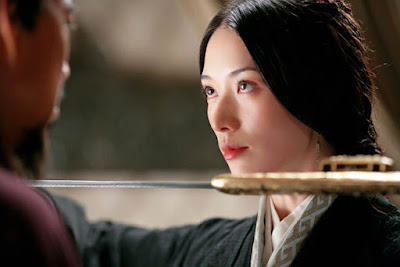
The story of Red Cliff kicks off with the feared General Cao Cao (Zhang Fengyi) seeking to finally consolidate the Han dynasty by conquering two warlords who have stood in his path, Liu Bei (You Yong) and Sun Quan (Chang Chen). On the run after a ruinous battle with Cao Cao, Liu Bei seeks to form a military alliance with Sun Quan, but first must win the trust of Sun Quan’s viceroy, Zhou Yu (Tony Leung, reuniting with Woo for the first time since 1992’s Hard Boiled). Zhou Yu is a mighty warrior, whose wife Xiao Qiao (Chiling Lin) is regarded as the most beautiful woman in China, the Helen of Troy of her land and time. The two kingdoms do join together, but still face seemingly insurmountable odds against Cao Cao, requiring innovative military strategies, one after another. Woo has designed these battle sequences with great thought, rather than just overwhelming the senses with CGI-generated sound and fury. The strategy of each side in the battles is revealed, thrown against each other, and then we see how little tweeks in those strategies make the difference between victory and slaughter. Not to make Red Cliff sound like a dry exercise in medieval military planning - when Woo does cut loose in the countless action flourishes throughout Red Cliff, it is all the more exhilarating because he has earned it by slowly building the tension of the battle scenes, along with the storylines of both the lead and supporting characters. The version of Red Cliff that is being released theatrically in the United States is a two and half-hour cut, as opposed to the two-part, five-hour version released in most of Asia.

Note that there are plenty of SPOILERS ahead in terms of plot, as Woo discusses how various sequences were filmed.


You’ve done big movies before, but I don’t think anything quite on this scale. Were there moments where you looked out on the vast numbers of people and sets and extras and were daunted by what you had at your command?

John Woo: [laughs] Yes. We had over 2000 people working on the set. We even had real soldiers working with us. 700-1500 at times, almost every day. Playing warriors and fighters. But this was a movie I had wanted to make for many years. Also, I had been working in Hollywood for over 16 years with so many good people here, and I thought it was about time to bring what I had learned in Hollywood, to Asia. There are so many young filmmakers in China, who are all eager to learn. They have such a passion about movies, and they all want to work on big-budget Hollywood type movies. So, I thought this was a great opportunity for them also. They have the same type of working style as Hollywood, but all they need is the opportunity.


(Chiling Lin, above.)

You created some physically impossible shots, such as the when the carrier pigeon is released and we fly along with the pigeon (In a scene in which the bird travels across the battlefields and opposing camps, laying out the topography of the land.). I thought that was an interesting contrast, because so much of what you have in this film is so obviously physically there. But you must have had to use computer images to create those otherwise impossible shots. How do you find the balance between what you are able to do on the computer and what you want to have physically in front of the camera?

We shot a lot of real live action on the set, and we also used computer technology to add more people and more battleships. I think the team did a very job, and were very clever, in combining the real, live action and the CG. It’s usually hard for the audience to tell which is which. There are some obvious fake moments where the camera follows the pigeon over the enemy’s sides and across the river. That shot was trying to show the geography of both sides. It was if Red Cliff were in Los Angeles and the enemy was in New York, and we had to use this pigeon to connect them together. It became one of the most expensive CG shots in film history, because it was so long and there was so much movement. The other biggest movement was the ship sequence, in which the hero sets their boats on fire, a entire enemy navy of 2000 ships. Because of the direction of the wind, the entire enemy navy is set on fire. It was a brilliant strategy, and it was done with CG. A lot of detail. (In the final Battle of Red Cliff, the Navy of Cao Cao interlock their boats together, forming a blockade, but the Allied armies wait until the wind changes in their favor, and then ram the much larger Navy with “fire boats,” which set the entire Navy ablaze.)

In terms of getting the details right, there are different countries that know of this story, and there are also different comic book versions of it. But what was most important to you in terms of the details when you were writing it yourself?

There were a lot of characters, and I had to make a lot of changes. Actually, I didn’t do that much to follow the book and history. Originally, all those characters in history, they were pretty much like gods, or legends. Always serious. People admired them and no one would want to make a joke of them, because people would find it so offensive. But I wanted to make the film more international, and that’s why I made the characters more human, instead of super heroes. I wanted the modern audience to be able to relate to them. And also, I increased the female role, which didn’t exist in the book. The movie is all about team work, and I thought the women should have their contributions. I also wanted to show that the classic Chinese women were known for their beauty, but they were also had very strong personalities. Just like women nowadays. They are very brave, and smart, and can take on all sorts of challenges. They can sometimes do a much better job than men [laughs]. I didn’t much follow the book. I realized that I wasn’t making a television series for the History Channel. I am making a movie. A movie should have its own message.

Is it controversial in China to see the story changed so much?

It has some controversy about it, the way it was changed. Some people didn’t feel comfortable with it. And some people were expecting to watch a historical film. But it was a small group of people who didn’t feel comfortable with it, and in general, the younger audience…they love it. Especially the European audience. They love the idea of increasing the female part. It’s very important for the movie.


I wanted to ask you about the scene with the interlocking boats. I’ve never seen anything like that before. Was that historically accurate?

Yes, that was from history, and also from the book. It was fascinating and a very clever strategy.

(The burning boats sequence, above.)


The elements played a big role in the strategies as well.

The elements were a major issue in the movie, like in the burning ship scene, where the enemy navy was set on fire because of the wind. That’s all because of the weather. That’s something I learned from [studying] Napoleon and Hitler. They lost wars because of the weather. That’s something that is also [different] from the book. With the boats. [In the book] one of the major characters says “Call the wind!” to win the war. It was kind of like he had super-powers. I wanted to do something different from the book [with that action]. Something more natural. More believable.

Are there significant differences between the versions released in different parts of the world?

Yes, the Asian people are so familiar with this part of history, and the characters, that we have much more time for developing the characters. In the Asian version, there are two love stories. However, the American audience, they aren’t as familiar with the history and characters…we decided to focus on the main story. We took out the love story with the Princess and the young soldier, and also trimmed down the side characters, and focused on one story. But it’s still the same story, the same excitement. Some people even feel that the American version is more exciting, and tighter. So, I’m very enthused with both versions.

Is it easier for you to make a film in the Hollywood system, or in Asia?

Let me put it this way - it’s always easier to make a movie like Red Cliff in Asia. In China, everything was so simple. I just went into the office and let them know I wanted to make a movie called Red Cliff, and they said, “Okay, let’s do it.” [laughs] It was that simple. And I didn’t have to take notes from anyone. I didn’t have to take any advice from anyone. I didn’t have to take any meetings. I just closed my door and worked with my team and did my own thing and made my own film. And also, we had great support from the government. We had soldiers, and all kinds of help from the local people. They also have the biggest studio in Asia. The size of Universal Studios with big sound stages, all types of facilities. Of course, one thing I miss about Hollywood is that everything is so professional. I love to work with the crew and I love to work with the actors. They’re so dedicated. The people in Hollywood have an open mind and they give a warm welcome to talents from all over the world. I learned so much. Of course, I never get used to all the meetings [laughs] and that there are so many people involved in the project [laughs] and how long it takes to make a decision. But there are great things in both places.

You say that there was no interference from the Chinese government, but they are well-known for not wanting certain things in movies. Did you have to trim anything down for the Chinese version, such as the lovemaking scene?

No, I didn’t have to trim anything down for the movie. Actually, they’re getting more open. They’re not that tough. They’re very reasonable. The only concern was the violence - I think it’s the same as other countries - because they really didn’t want to give any bad influence for the young people. They don’t have a ratings system. There’s a movie board, and any kind of movies are for all kinds of audiences. So, we just needed to pay a little attention to that. I didn’t want to show a guy chopping a head off, or something like that.

We live in a war-torn globe today. Since the movie broke box office records in China, and did well in Europe, do you think people are relating this story to what is going on in the world today?

I think so, and I hope so. Before I made this movie, I realized that the economy is getting worse, and affecting so many people. And I overheard some young people in Asia...they were so frustrated. They were all in a deep depression. Some young people didn’t know what to do, didn’t see much hope, didn’t see the future, and some people even gave up their life. It happened in Japan, Korea, Hong Kong, and other Asian countries. I felt so sad. I feel the young people need someone to care about them and they need encouraging. That’s why I hoped this might change their ideas. The movie was about a smaller army that could defeat a larger, more powerful enemy through a combination of teamwork, intelligence, and courage. I think it’s an encouraging movie. I just try to let young people know that they are not alone. There is always a friend. Just work together with your friends and family and take charge. There are always good people. The movie was such a success in China, and Japan, especially in Japan…some of these young people would cry in the movie, they were so moved by the story. And I would ask them “Why?” They would say that they were watching Tony Leung in the film, and they wished they could have a friend like him. Another important thing was that it was also a war movie, and I had wanted to stress that in war…there are no winners. Before, my kinds of movies, they were usually all about the tragic hero. Now, I’m more personal, as I’m getting in age [laughs], I care more about what people really think, and what people really want, when I make a movie.

Which version of the film will we see on the DVD in the U.S.?

I think they will release the 5-hour version in the States. They should.

There was a special section recently in The Hollywood Reporter that was presenting China as a real emerging filmmaking partner. Do you think that it’s finally happening that are real bridges of connection between Hollywood and China, and China is going to open up as a real force in the global industry?

I think so. The Chinese government is open to all kinds of foreign production. They have the biggest sound stage in Asia. A fine mixing room and visual effects team. The business is growing. Since Red Cliff was such a success in China, and also, other fantastic Chinese films…the audience wants to see all types of movies. They keep building theaters, and a lot more of the 3-D cinema [laughs].

The instant philosophical connection to this film is to Sun Tzu’s Art of War. I’m wondering if there was any formal association to that. If you had immersed yourself in that text at all, or if it had come about naturally as a way of telling the story?

It’s a little of both, actually. After studying Sun Tzu’s Art of War, I had gotten some ideas, for designing the battle scenes, like the “turtle formation.” (During the Battle of San Jiang Kou, Sun Quan’s tough young sister, Sun Shangxiang [Zhao Wei] ambushes Cao Cao’s forces and leads them through a dust storm into a trap, the turtle/tortoise formation, in which the horseback soldiers of Cao Cao ride inside of the Allied Army, who have arranged themselves in a formation resembling that of a turtle.)

How had your working relationship with Tony Leung changed, or not, from when you last worked together years ago?

I was so happy to work with him again. He had become more mature, and even more charming [laughs]. He has the same kind of charisma, but this time, he feels more calm, more stable, and he cares more about the others. He’s a man with a big heart. We’ve known each other for such a long time, that we don’t need to say much. We sort of just look at each other and do it.

(Below, Tony Leung in 1992's Hard Boiled, and then in Red Cliff.)


Would you ever want to return to Hong Kong cinema?

I don’t think so. I prefer to make more movies in China, because Hong Kong is so limited. It’s hard to do anything else. There aren’t much in locations, or much in history. All you can do is keep repeating the same thing, but in China, there is so much interesting history and culture and so many different things. I’m still learning. I like to work in different countries and different cultures, and make new friends. In the future, I will maybe make a French, or German, or Turkish movie [laughs]. I want to make films in different places.

You’ve mentioned that your next project is going to be Flying Tigers.

It’s a World War II movie. It’s about an American volunteer team, who are working with the Chinese Air Force, to fight the Japanese during wartime, and they worked together so well, and they gave a lot of contributions, and they won the war. The main story is about friendship, the friendship between the Chinese and the Americans. It’s going to be a very challenging project. Just like Red Cliff [laughs]. There are going to be huge air battle scenes, a lot extra people, but also a lot of human moments.

Red Cliff will be released theatrically in the United States via Magnet on November 20th and is currently available via VOD. The official website is here, and the trailer is below:


Read More
Posted in A Better Tomorrow, Hard Boiled, Hong Kong cinema, John Woo, Red Cliff, Tony Leung | No comments

Willem Dafoe: The Hollywood Interview

Posted on 12:11 by Ratan
Actor Willem Dafoe.


"BEHIND THE SHADOW:
Willem Dafoe on portraying cinematic legend/enigma Max Schreck, being directed by Steve Buscemi, and how one prepares to play the Son of God"
by Terry Keefe


Editor’s Note: The following article appeared in the February 2001 issue of Venice Magazine.

Max Schreck. It’s a name that to film fans conjures up the unforgettable images of the cinema’s very first vampire, played by German actor Schreck in director F.W. Murnau’s 1921 silent horror masterpiece Nosferatu. Schreck holds the dual distinction of being both one of the most recognizable figures in film history and also one of the most enigmatic. Besides "Nosferatu", few, if any, of Schreck's films even exist anymore and almost nothing is known of his life.

Willem Dafoe. It’s a name that to film fans conjures up unforgettable images of his acting performances in some of the best films of the past 20 years. And it is Dafoe who has brought the mysterious Max Schreck back from the grave in Lions Gate Films’ Shadow of the Vampire, a deliciously macabre tale of historical fiction about the making of “Nosferatu”. The film’s hook is that Max Schreck was an actual vampire hired by F.W. Murnau for the purposes of realism. Dafoe turns in a terrific performance as the vampire Schreck in a role that might have been very one-note in another actor’s hands. But throughout his entire career, Dafoe has specialized in adding layers of depth and humanity to challenging characters. Along the way, he’s also been unfairly saddled with the image of an actor who specializes in playing odd or peculiar roles. A closer examination of his career reveals a deeper truth - that he’s a daring artist who simply refuses to be satisfied with the creation of the bland or ordinary.

Willem Dafoe was born on July 22, 1955, in Appleton, Wisconsin, the second youngest of eight children. After leaving the University of Wisconsin, Dafoe made his way to Manhattan in the late 1970's where he became one of the founding members of the Wooster Group, a now-famous theater company which has been a pioneer in incorporating experimental elements of multimedia into the theatrical language. Dafoe still performs with them today.

Dafoe made his screen debut as a featured extra in Michael Cimino's legendary cinematic disaster Heaven's Gate. Things could only go up from there and they did, as Dafoe was cast as a beatnik biker named Vance in Kathryn Bigelow's little-seen 1982 feature The Loveless. Dafoe's next big role was also as a biker, of a very different sort, as he played the evil Raven in Walter Hill's underrated rock 'n roll fable Streets of Fire in 1984. But if Raven was a great villain, he was only a warm-up for Eric Masters, the counterfeiter/painter that Dafoe portrayed in William Friedkin's brilliant To Live and Die in L.A., which was released in 1985. Masters is the perfect L.A. villain - a talented artist who also happens to be a merciless killer - and Dafoe colors Masters with so many realistic mannerisms that he becomes far, far scarier than the average criminal antagonist.

Then came the film that changed everything for him, Oliver Stone's Platoon in 1986. The shot of Dafoe as Sergeant Elias, riddled with bullets and his arms stretched towards the heavens, would become the defining image of the film. And "Platoon" would finally bring Dafoe both worldwide fame and an Oscar nomination for Best Supporting Actor. It's perhaps ironic that Dafoe's good-hearted Sergeant Elias is derisively referred to as a "water-walker" by another character in the film, because the next major role Dafoe would take would be as Jesus in Martin Scorsese's The Last Temptation of Christ. This choice as a follow-up to "Platoon" is all the evidence you need of Dafoe's daring as an actor. While it's true that this was a lead role in a film directed by Martin Scorsese, "Last Temptation"'s controversial subject matter was guaranteed to offend many, and for an actor who had only just broken through with mainstream audiences, it was a risky move. But it was also very characteristic of the path Dafoe's career would take during the next decade. With the possible exception of 1997’s Speed 2: Cruise Control, rarely will you see him in a big studio blockbuster that was done just for the exposure or the paycheck. The one thing you can always count on from a Willem Dafoe project is that it will be interesting, at the very least, and usually much more than that.

His next film after playing the Son of God would be an acclaimed teaming with Gene Hackman as a pair of mismatched F.B.I. agents investigating a hate crime in 1988's terrific Mississippi Burning, directed by Alan Parker. Other notable performances include Wild at Heart (1990, as the vicious hit man Bobby Peru, for director David Lynch), Clear and Present Danger(1994, as government operative John Clark), Tom & Viv (1994, playing poet T.S. Eliot), The English Patient (1996, in which he was the mysterious war veteran Carravagio), Affliction (1997, as Rolfe, the long-suffering brother of Nick Nolte's Wade), and American Psycho (2000, playing Kimball, the police detective hounding the serial killer of the title).

This past fall, Dafoe starred in Animal Factory, the second film to be directed by Steve Buscemi. Dafoe plays Earl Copen, a lifer con who is the top dog in the prison yard, and who enters into a relationship with Edward Furlong's much-younger character Ron. It's a definite love story, but the film skirts the usual genre conventions by keeping the relationship almost entirely cerebral. "Animal Factory" is based on the book by Edward Bunker, a former con turned writer-actor who many also remember as Mr. Blue in Reservoir Dogs.

Which brings us to the present and "Shadow of the Vampire", directed by E. Elias Merhige from a screenplay by Steven Katz. As mentioned earlier, little is know of the real-life Max Schreck and this has led to endless speculation about his true story by fans of "Nosferatu" throughout the years. The most famous quote on record about Schreck is that a prominent German film producer once referred to him as "an actor of no distinction". And then there's the name - the word Schreck in German loosely translates as "shriek" or "scream", and it seems likely that it wasn't the man's real moniker. "Nosferatu" is shot almost like an early documentary and the film has a creepiness that stays with you for days. All of these factors provided fertile ground for "Shadow of the Vampire"'s take on what really happened during the making of "Nosferatu". In fact, watching the original again after seeing "Shadow" is a very unsettling experience. You're left thinking "what if?"

As Schreck, Dafoe is a quivering, scheming mass of long claws, fangs, vanity, and loneliness. Remarkably, Dafoe creates a Max Schreck who is not only scary and sad, but also very funny. Although he's uncomfortable in front of the cameras at first, Schreck soon becomes something of a prima donna, asking for more make-up and questioning parts of the script. Dafoe also re-creates the real-life Max Schreck's original performance beat-for-beat in the "film within the film". It's a multi-layered, tour-de-force performance worthy of an Oscar.

In January, Dafoe began shooting the much-anticipated Spider-Man with director Sam Raimi. He'll play yet another icon in this one: Norman Osborne, who any good comic book fan knows is also Spidey's arch-nemesis -the sinister, pumpkin bomb-throwing Green Goblin. One imagines that the make-up required for "Shadow of the Vampire" will have been a good warm-up for what Dafoe will be wearing as the Green Goblin - in the comics, the Goblin is covered with green scales, has pointed ears, and flies around Manhattan on an airborne "goblin glider"! And it’s a safe bet that because it’s Dafoe behind the mask, the Green Goblin will have a lot more depth than your typical wisecracking comic-book villain. We sat down with Willem Dafoe this past December to discuss his career and all things Schreck.

Can you tell us about your preparation to play Max Schreck?
Well, there wasn't a lot I could do until I got in the make-up, in the costume. I read about Murnau. I looked at his films. I certainly acquainted myself with "Nosferatu", because I had to be well acquainted with the film...I had certain sequences that I knew we were going to replicate that I had to know very well. Also, I knew I wanted to have an accent, so I got some Slovakian accents from the Tatrus Mountains (in the South of Poland) and listened to them, then scored out an accent with a dialogue couch in New York. And then just made certain adjustments for clarity and what felt right. And through that, I found the voice, which of course had to be invented because there's nothing to copy in that case. Then it was really about dealing with the costume and the make-up, which was everything because that became the key, that became the mask, that became the mode to find the character, because it was so extreme that it informed everything you did.

When you finally did get into the make-up then, did you have to spend a lot of time finding the character further or was it immediate?
It was fairly quick. We did some tests. Then every morning of the shoot, I'd be the first one there. And it was three hours of make-up, which was always a great preparation for the day. Because you're sitting there every day for three hours and you have to be quite still because some of it is quite delicate work. And you look in the mirror and it was a process of seeing 'you' as you know yourself, what you identify with individually as yourself, starting to recede away and having this other character come forward, as you became more and more obscured. So you start to look less like yourself and then you start to feel less like yourself and then you start to even think less like yourself, because you're encouraging that transformation willfully. Then you apply yourself to the story and certain impulses come.

When I tried to find out more about the original Max Schreck, the only thing I really learned is that he was once referred to as "an actor of no distinction". Is that pretty much what you found out?
That's pretty much it. But to tell you the truth, I didn't feel that compelled to find out that much about him because, although any information can be useful, I was most interested in the Max Schreck of the performance, of the performance as Count Orlock. That's what I was dealing with. The other part was really the invention of Steven Katz' screenplay.

I was just curious about what you thought about Max Schreck as an actor.
Oh, I think he's great. You know....traditionally, silent film acting is considered hammy and unsophisticated and amateurish. But if you kind of let go your criteria for what is 'acting', which is usually based on our notions of realism and naturalism, there's some very beautiful things that happen (in Schreck's performance). In his awkwardness, there's a grace. There's a poetry to his simple actions. We aren't handing out prizes here, and it's particularly not important when the guy's been dead for so long. So whether he's a good actor or not, I don't know. But I do know that in watching him, there is some poetry.

How was working with your director, E. Elias Merhige?
It was great. An actor wants a good set-up. He gave me a good set-up, and he kept me on track. And then some. He's very supportive. He's very passionate about what he does. He paid alot of attention to the technical aspects of it, to create the conventions in the "film within the film" sequences. He's quite ambitious and quite driven and I think on some level he identified with Murnau (laughs). But in other ways he's not at all like Murnau, because he's very sweet and very warm.

You recreated Schreck's performance flawlessly for those "film within the film" sequences. How many times did you watch "Nosferatu"?
We had it on the set. I mean, we watched it a lot, but then...we had a cassette of it available always. And sometimes we'd huddle around it and there'd be debates about actually what we were seeing. We would get together and it would be amazing how some people would see different things than other people, watching the same thing. It was a lesson about perception. And sometimes we'd argue about what we actually saw. Because the rule was that, as much as possible, we'd try to recreate those moments.

Murnau and the Vampire are very similar people. It's very hard to say who's the real monster and also who's really directing the project.
As Schreck says in the movie, "We are not so very different, you and me." (laughs)

I wanted to talk about another film of yours that was just released, "Animal Factory". Could you tell us a little bit about working with the director Steve Buscemi?
Sure. Steve's an old friend and I only mention that not to name-drop, but that does make a difference in this case. I've known him for many years. I knew him when he was a fireman, before he was an actor...he was a New York City fireman in Little Italy. And he was doing his comedy sketches with Mark Boone Junior in the clubs. And I went off to do "Platoon" and he filled in for me at the theater, at the Wooster Group. And then I've known him through the years and we've kept in touch. And when this project came up, he said he wanted me to do it and I thought it was a beautiful story. It was fun being directed by someone you knew very well because you could skip to the chase on alot of stuff. And he directed me like an actor, because the language is there. I also felt like sometimes it was almost as if he was doing the role, but he was doing it through me.

Let's talk about your background a bit. You were raised in Wisconsin and you're the second youngest of 8 children. That's a big family - were your parents or any of your siblings also artistic?
They're all artistic but professionally they did other things. It's the old story - I'm the actor but when we get together for a family reunion, they're all far more talented than I am (laughs).

When did the acting bug get a hold of you?
When I was quite young...I was in school plays, and I was in summer stock. Then I went to Europe for a little while and I went to New York. And 23 years ago I started working with the Wooster Group and I still work with them now.

It seems like it's a great balance creatively to be able to do both the Wooster Group and the films.
It is. Sometimes it's frustrating because sometimes I feel like I'm cheating one world when I go to the other one. It's like having two lovers. But at the same time, being with one makes you better for the other one (laughs). Not sure if I should say that - get me in trouble! (laughs again). No, for me, sometimes it's hard because you have two masters. But sometimes it's good because when you go back and forth between the two it always forces you to find out why you do what you do. It really is a great insurance against falling into a routine.

One of your first major film roles was in 1985, when you played Eric Masters in William Friedkin's "To Live and Die in L.A.". It's a terrific film which was kind of overlooked at the time it came out.
It was. It's actually a film that directors have responded to. And I think I got alot of work in my early days from that movie. That was a very important movie for me. People, key people, really responded to it. It was seen as a failure. It was an independent at the time, when independents seldom got that kind of release, with a prestige director and basically an unknown cast. But the thing that I remember about it was that a lot of the reviews said the same things and I think it was ahead of its time, because they basically said, "We don't know who to root for. Everybody's so horrible in this. There's no one that we can identify with. This is a crummy movie because you've gotta have someone to identify with. These people are so corrupt." Well, I think Billy Friedkin somehow prefigured the coming of the kind of love affair with the anti-hero that someone like Quentin Tarantino knew so well and audiences responded to.

In 1986, you filmed a role that really catapulted you into the national spotlight, that of Sergeant Elias in Oliver Stone's "Platoon". Could you talk about the production a little bit?
I just remember meeting Oliver and thinking, "God, I don't know anyone in Hollywood like this guy!" (laughs) I loved the preparation for it, the training, it was very tough. We had people that really cared about what was being conveyed, so there were really high stakes in making the movie, Vietnam Vets that wanted their story to be told. So the training and the whole movie was done in a spirit, a very intense spirit. I loved making it. But I thought, because you've got to remember the climate at the time, I thought, "This movie is not going to see the light of day. There aren't any big stars in it. It's the kind of war movie that could be seen as depressing to some people. It could have political problems for some people. This is going to get misidentified and wind up on a video shelf next to kung-fu movies." I really did think that. And that's no judgment on what I thought we were making. It's a judgment on how I thought it would get to an audience.

The next major role you took after “Platoon“ was “The Last Temptation of Christ“. Did you have any reservations about taking the role?
No. And I've said it before, I don't know why I didn't (laughs). No, I didn't because the way Marty approached me...saying what kind of Christ he wanted it to be. I thought, "I'm the perfect guy to play this." And I think that movie probably had a profound influence on me, professionally and in my life. It was a great experience. It was a movie where I really felt used, I mean “used” in the best sense of the word. As an actor, I want to be used. I want to use my body and my mind, my voice, whatever I've got, for something. And Marty had this beautiful story to tell. He made this movie in his head for many years, and I felt privileged to be involved in it. It was a deeply felt experience, and when I finished it, I felt really spent. And that's such a good feeling.

What type of preparation did you do to play Jesus?
As little as possible. I mean, the thing that I'm always struck with is that it was more a process of elimination rather than accumulation. Because you wanted to cleanse yourself of any kind of expectation. The whole notion of the way the story goes, Jesus is a very reactive character. He's dealing with what is being presented to him. So you want to be in a place where you could receive that without knowing the outcome too much, you wanted to be very open-hearted and open-minded about it. So it's like sometimes I think I like to start from a place of not knowing, probably end up at a place of not knowing too (laughs) but in that one (Jesus) deeply there was an aspect of him that was like an innocent, so I didn't want the overview. I didn't want the information. I just wanted to deal with it as it was presented to me. And because it was so well-designed and it was framed so beautifully, that was a good place to be.

You made a lot of comic book fans, including myself, very happy when you agreed to play the Green Goblin in the "Spider-Man" film that you're about to shoot with Sam Raimi.
I'm excited about it. But there's not a lot I can say about it right now. Not purely for secrecy, but because I'm just starting. There's a lot of comic book fans we've got to make happy. The stakes are high (laughs).
Read More
Posted in Animal Factor, Eddie Bunker, Martin Scorsese, Max Schreck, Oliver Stone, Platoon, Sam Raimi, Shadow of the Vampire, Steve Buscemi, Willem Dafoe, William Friedkin | No comments

Steven Soderbergh: The Hollywood Interview

Posted on 11:47 by Ratan
Filmmaker Steven Soderbergh.


STEVEN SODERBERGH:
HIDING IN PLAIN SIGHT
By
Alex Simon


Editor’s Note: The following article appeared in the July 1998 issue of Venice Magazine.

Steven Soderbergh was born January 14, 1963 in Atlanta. Raised in Baton Rouge, Louisiana, he was still in high school when he enrolled in a film animation class at Louisiana State University, where his father was dean of the College of Education. Soon he began making film shorts with equipment he had borrowed from students at the university. After graduating high school early at 17, he decided to skip college and headed for Hollywood in a frustrated pursuit of a movie career. Back in Baton Rouge, he worked as a coin changer at an arcade and in his spare time made a humorous short called Rapid Eye Movement, about his Hollywood non-experience. Eventually, he landed a job at a video production house and enjoyed some success as the director of a music video for the rock group Yes, which was nominated for a Grammy. He began writing screenplays and directed a short called Winston, about sexual deception, which he later developed into his first feature Sex, Lies and Videotape, which was the hit of the 1989 Cannes Film Festival, winning the coveted Palm D'Or as Best Film, as well as the International Critics Prize and Best Actor for James Spader. It also earned an Oscar nomination for Best Screenplay. Soderbergh followed this with Kafka in 1991, a surrealistic mystery/suspense film which combined fiction with elements of author Franz Kafka's life. He followed that with an adaptation of A.E. Hotchner's memoir King of the Hill in 1993, a heart-rending coming-of-age tale set in the depression-era midwest. Despite not fairing well at the box office, it remains one of the best-reviewed films of that year. 1995 brought The Underneath, Soderbergh's take on Raymond Chandler-esque mystery, set in present day Austin, Texas. 1997 saw two Soderbergh releases: Schizopolis, a low budget, experimental comedy in the spirit of Richard Lester and Buñuel, and Gray's Anatomy, a filmed version of Spalding Gray's comic monologue.

Soderbergh's latest is one of his best, and certainly his most commercial efforts yet. Out of Sight, from the novel by Elmore Leonard (Get Shorty), reunites Shorty screenwriter Scott Frank with the author and boasts an all-star cast featuring George Clooney, Jennifer Lopez, Ving Rhames, Don Cheadle, Albert Brooks and two huge stars (who will remain nameless) in very crucial cameo roles. Out of Sight is a treat for the brain, the eye, and the funnybone, a film which combines the best of 1970's American film grittiness and a 90's hipness that makes for one very refreshing celluloid cocktail. Universal opened the film wide on June 26. Odds are you'll want to check it out more than once. Steven Soderbergh sat down recently to discuss his latest film opus, as well as his past triumphs, tribulations and disappointments.

I'm a big Elmore Leonard fan and I thought you really captured his voice with Out of Sight, which isn't easy to do on film.
Steven Soderbergh: It's tricky. It's an odd tone. We had two things going for us: Scott Frank, who understands that tone, and we put together a cast that I made sure understood that tone.

Have you always been a fan of Leonard's work?
Yeah. I've read probably six or seven of his novels. I've seen almost all the movies that are based on his work. So I was very familiar with his work.

I was excited when I heard you were doing this film, because like Elmore Leonard's novels, most of your films have subject matters that seem very serious when you first hear about them, but they always seem to have undercurrents of humor. Even with Kafka, a writer whose work most people find to be completely bleak, but I've always found to be blackly hilarious, you seemed to find that same humor and absurdity.
I think Kafka's work is extremely funny in an absurdist way. With (the film), I think a lot of people took it much more seriously than we intended, dealing with that character and all, leaves you open to that. But we really saw it as a carnival ride.

The Underneath struck me as sort of an homage to a Raymond Chandler-type crime story, whereas Elmore Leonard definitely has a more modern take on the genre, more straightforward.
Well, ultimately (The Underneath) was kind of a mess. I didn't quite unlock it or figure it out. Some things about it are interesting, but others are...if there's a successful element to The Underneath it was finding a way to use color in the same way that noir films used to use black and white. That was the one part of the movie that worked. Everything else about the movie I can't defend. It was a failed experiment, but a good experiment to attempt. The results of that experiment were necessary in making (Out of Sight). They can't all be gems. It's a process.

I noticed you were very specific about the color palates in Out of Sight, depending on what city the scene took place in. Did you use a blue filter in most of it?
No. More often than not we shot with a half-85, which cools things off a bit. Then on some stuff we'd just pull the 85 completely, and let it go blue, then print it back. And what happens when you do that is there's a patina of coolness in the blacks. And that gives you a different feel than if you shot it with an 85 and then tried to tone it down, trying to get it to look like winter, for example. We did a lot of experiments, depending on how the light was that day. I love that look. It's very evocative. It's what I saw when I read it. It had that feel...It felt like a real 70's movie to me.

Another filmmaker that comes to mind when I watch a lot of your work is Antonioni, especially in your specific use of color.
I think a big problem with The Underneath was that I was in danger of becoming too much like Antonioni. I think he's terrific, but I think at some level, it's not an appropriate style for an American filmmaker because it runs so counter to our zeitgeist. I appreciate the rigor of that style of filmmaking, but what I felt Out of Sight needed was a combination of being that thorough, with a much more jagged energy and a much more rough style.

Out of Sight didn't feel "slick." I noticed you didn't use many dolly shots, did a lot of hand-held stuff, and a jarring editing style that was very effective.
Yeah, for this material I felt that if the movie smelled like Hollywood it would just fall apart.

You had a star-studded cast in this film right down to the smallest parts. How did you attract such a stellar group?
Well, Elmore Leonard's got a reputation for writing great parts, even great small parts. But in the case of the two cameos, we were really lucky. Both actors were intrigued by the idea of doing these small roles that were extremely important to the story in spite of their size, and also they did it as a favor. But, particularly in the last scene, if it weren't (this actor) it had to be someone who had an extremely powerful presence. Because you're talking about a guy who you have to establish in no time at all that he's "the dude." The break-out artist of all time, otherwise the last scene of the film wouldn't work--if that guy didn't have that power.

The other great thing was that everybody in the film underplayed, very naturalistic.
That's Leonard's style, too. The characters have no self-awareness at all, so if you cast an actor who comments on their performance while they're giving it, you're dead.

Talk to us about George Clooney, who I think is an incredibly underrated actor.
He absolutely is. He's in that weird spot, which I hope he won't be in much longer, where people are saying "He should be a movie star!" He makes four movies and they do okay, but they don't set the world on fire, and everybody blames him. I've always thought that the guy was ready to happen, and there was no question in my mind that this was that part for him.

How do you direct actors?
I try not to ask them how they like to work, I try to find out, and that's where rehearsals come in...I try to have a week to ten days of rehearsal, which is really for me, not for them. It's for me to watch them, and get a sense of how they like to be treated, how to communicate with them so that I don't have to figure it out on the set, where I'm not as patient. (All the actors) are different, so you have to treat them accordingly.

What sort of space do you like to rehearse in?
We just had an open space, sort of a holding room, over at Universal that was fairly good-sized. I'd bring in some props and tables and things, do a read-through for a while, then put it on its feet, do a little blocking.

Do you have a clear idea of how you're going do shoot beforehand? Do you storyboard at all?
No. Figuring out where to put the camera is usually the easy part. It's coming up with some way of staging the scene that's interesting, that's the hard part...the only thing I boarded on this movie, because we shot the whole sequence out of order, was I took stand-ins and moved them through the entire mansion sequence from beginning to end, and then with a still camera with a zoom lens, shot from every angle I could think of, then put those up on a big board. Every time we did a shot, I'd put a piece of red tape on that corresponding picture.

Hearing you talk, you seem to have a natural affinity for filmmaking. Did you always love movies growing up?
Oh yeah, I always loved movies, but I don't think...I think it's something I like to do and something I feel comfortable doing, but I don't think I have an innate ability for it. There's certain things I think I do well, but I see films by other people all the time where I say "Jesus Christ, I could never do that!" There are a lot films that just leave me in awe...Something like Titanic, you could put a gun to my head and say "Direct this." I'd say "Go ahead and pull the trigger," because I wouldn't know where to start. My mind just doesn't work that way. But, odds are that (James Cameron's) version of Sex, Lies...would be pretty strange. (laughs) But he's good at what he's good at. It takes a while to figure out what you're good at. Part of maturing I think is recognizing what you're good at and refining that and focusing on that, instead of spreading yourself out too thin and trying to be a jack-of-all-trades. And that takes a while to learn, because the ego part of you wants to say "I can play on anybody's court, anywhere, anytime." Instead of saying "Hey, you know what, I'm not very good on clay, I'm gonna stick to grass." And it's true.

Were your parents involved in the arts?
My dad was a college professor who drew a little bit, and he loved books, and he loved movies and he loved music. My mother when she was younger painted, but by the time I was growing up had stopped. It was certainly a household where I was encouraged to explore that stuff and supported endlessly by them.

Any siblings?
Yeah, I have three sisters and two brothers...I was the fifth.

You didn't go to a formal film school, so how did you develop yourself as a filmmaker?
Trial and error...I was hanging out with these LSU students when I was in high school who had access to some university film equipment and we were all sort of experimenting with this stuff. And some of the people I'm still working with. Paul Edford, my production sound mixer, was one of the members of that film class. It was a pretty unique group, all have gone on to do interesting things.

Did those early films that you all did get you attention early on?
Not really. They were just résumé pieces for me that I'd show to people for specific reasons.

I heard your first move to L.A. wasn't so pleasant.
Well, I came out here when I was 17, was here for a year and a half and I was getting some editing work for a TV show called Games People Play that got canceled. It was a dreadful show, but the segments that we got to do were interesting. They were filmed segments, which in the early 1980's was a new thing to do, shoot 16mm negative, transfer it to tape, and then post on tape. So, the show got canceled, I kept doing piddly jobs and figured, 'Well, I can starve a lot more comfortably back in Baton Rouge.' So I moved back, kept making shorts, kept writing and...writing is really what kept me going. I eventually wrote enough stuff to get an agent and get work, and with that money I financed a short film...and eventually did Sex, Lies.

How did you get the job for the Yes concert film?
I had been doing freelance work for Showtime and someone there recommended me to the band. They wanted to make a little "on the road" documentary, so I figured what the hell, I'll never see these people again, so I edited it into this sort of snarky, cheeky 30 minute film about life on the road with the band. They really responded to it, thought it was really fun. So they called me up and asked if I wanted to do the concert film. I said "Shit, yeah!" Here I was, 22, a pretty big thing to do...So I got an agent out of that and had been writing now non-stop for five years and had just started writing stuff that didn't completely suck.

How many did you have to write before they stopped completely sucking?
Probably one a year, from '80 to '85. Then in late '85, I wrote three back-to-back in like six months. I finally just crossed a line where something unlocked and I wrote these three...and that's when things started to open up. The first paying writing job I got was to re-write a one hour Disney TV movie that never got made.

Was there any one movie that really captured your imagination growing up and inspired you?
There were lots, tons. I'm editing a book of interviews right now that I did with Richard Lester. He was a huge influence, still is.

One of my favorite movies is Robin and Marian.
Great film. Look at this guy, talk about underrated and under-appreciated. He invents rock video with A Hard Day's Night and Help. The Knack, How I Won the War, Petulia which is a masterpiece, the Three Musketeers films which are hilarious and fun, Juggernaut, which is a great movie...Great filmmaker, with a wide range of films and genres.

I even liked Cuba, which got killed when it was released.
That's a fascinating movie. Flawed, but really the things that people disliked about it when it came out are what makes it interesting now, it's refusal to sort of play to the idea of a war-torn romance. An absolute refusal to be sentimental or easy about anything. Brooke Adams' character was really fascinating. Here's a woman who says "Look, I don't know what little fantasy you've got in your head, but don't play it out on me, because I'm not that." And this guy (Sean Connery) who wrestling with the fact that the kind of guy he is is obsolete now...It's a really interesting movie.

Why did Lester stop making films?
It was a combination of things triggered by the death of (actor) Roy Kinnear during the making of Return of the Musketeers. Lester was absolutely devastated by that and hasn't made a feature since. But he's an incredibly bright, kind, funny man. For my money, I wish he was still directing movies because I think he's still got movies in him.

So many great directors from that era that inspired your generation seemed to have just vanished. What happened do you think?
Well, as we know from reading the Peter Biskind book (Easy Riders, Raging Bulls), a lot of them just self-destructed. It was their own damn fault for the most part. Part of it was the business changing, but the lion's share of it was them. They just went out of their heads...I watched a lot of 70's films preparing for Out of Sight: all of William Friedkin's films, all the early Hal Ashby films. It was a great time.

Let's talk about King of the Hill, which reminded me of some of the best of Truffaut and Louis Malle.
They were definitely in our minds, especially The 400 Blows...Everything about that movie went flawlessly during the shooting. Then once it was done, everything went wrong. We finished the movie, took it to Cannes, got our heads handed to us. They fuckin' hated it. Hated it! Just a disaster. Not good long lead reviews, very mixed. Then we're coming out in August of that year on the heels of ten movies with children protagonists. Ten! Then the daily reviews come out and they're as good as I've ever gotten, but by then it was too late. It was a disaster.

I think it will be one of the films that you're remembered for.
It's the movie that people always bring up to me the most as their favorite of mine. As a classical piece of American narrative, that's about as good a film as I know how to make. But what happened afterward doesn't affect my memory of making the film, which was a great experience.

Let's go backwards and talk about Sex, Lies. Walk us through winning the Cannes Film Festival.
Well, the great thing about it is that it's a surprise. You don't take out ads to win the Palm D'Or. We screened very early in the festival, within the first couple of days, and notoriously that's not a good spot. But, the film went down well, we did our press, and then we went home, back to L.A. A couple people said that I might have a shot at the Camera D'Or, for best first film, and that they'd let me know. Then I got a call from Mike Watts, who was running Virgin at the time, and he said "I think you better get on a plane. I think you're gonna win the Camera D'Or and it's worth coming over for." So I got on a plane on Sunday, get off Monday afternoon and get handed the International Critics Prize, which I would've come back for anyway! So I thought, 'Wow, that's great.' They rush me into the ceremony. Then I see Spike Lee and say "What's going on?" And he says he didn't get anything for Do the Right Thing. I couldn't believe it. It's a great movie and should've won something. So we sit down, then James Spader wins for best actor. And nobody's there but me, so I run up and accept for him...Somebody grabs me as I walk offstage and says they need to get me back to my seat. Sits me down in my seat as Wim Wenders is speaking, I don't think in English, about the Palm D'Or winner, saying it's a film by a young filmmaker, this is all being translated for me...and I'm thinking okay, could it be Mystery Train, could it be Do the Right Thing...and he says "Sex, Lies and Videotape." And immediately it's like you leave your body and watch yourself trip and stumble over people as you go on-stage. And at that point, I know I stood at the podium and said "Well, I guess it's all downhill from here," and I have no idea what I said after that. It's all a complete blank. I know that I was taken and put on live French television immediately afterwards, next to Denys Arcand and Bertrand Blier, neither of whom looked very happy, and I gave this interview, got up in a daze and walked out of the building, and left the Palm D'Or under my seat! (laughs) And as I was walking out the door, somebody says to me "Uh, do you think you want to take the award with you?" (laughs) It's more amazing to me in retrospect than it was at the time. It was almost like someone hitting you with a wand and saying "You're John Lennon for three hours," with that kind of attention focused on you. Having been back to Cannes a couple times since and watching from the outside, I think 'Man, that must've been nuts!'

Many people credit Sex, Lies with jump-starting the independent film business in this country.
They key word there is 'business.' If Sex, Lies had made half a million bucks, we wouldn't even be having this conversation. It made money, and as we know if something makes money, people are suddenly interested. As far as its cultural impact, it comes down to just that: money.

Do you have any advice for first-time directors?
Don't wait for permission. There is a long list of reasons you can give yourself not to start: "I don't have enough money." "I have some but I need a little more." "I don't know anyone." There are gonna be so many people who will tell you 'no,' don't add yourself to that list. Whether you do it or not, nobody gives a shit. The only person who gives a shit at the end of the day is you, and you can't worry about how it will look, or anything, you've just gotta go. You've gotta go. The rest of what happens to you will rest on the film itself, which is how it should be. But I always tell people, people are their own worst enemy. We know that. They key is to remove yourself from the enemy list.
Read More
Posted in Elmore Leonard, Francois Truffaut, George Clooney, independent film, Kafka, Louis Malle, Michelangelo Antonioni, Out of Sight, Richard Lester, Steven Soderbergh | No comments
Newer Posts Older Posts Home
Subscribe to: Posts (Atom)

Popular Posts

  • Ines Sastre : The Hollywood Interview
    [Ines Sastre in The Lost City] Note: This article originally appeared in the May 2006 issue of Venice Magazine. For those not in the know [v...
  • OSCAR NOMINEE VIOLA DAVIS: The Hollywood Interview
    Viola Davis: Making Mrs. Miller in Doubt By Terry Keefe [Note: This article will appear in this month's issue of Venice Magazine. Pictu...
  • PAZ VEGA: The Hollywood Interview
    PAZ VEGA: THE CAT’S MEOW By Alex Simon Spanish actress Paz Vega first gained international attention with her smart, sexy turn in Julio Me...
  • The Ballsiness of the Long Distance Runner: A Chat With Mumia Abu-Jamal
    By Alex Simon Mumia Abu-Jamal has been one of journalism’s most outspoken voices for nearly forty years. However, Mumia’s greatest fame has ...
  • Clive Owen: The Hollywood Interview
    CLIVE OWEN GETS BACK By Alex Simon Clive Owen is one of those actors that keep surprising you. Just when you think the audience, and the Ho...
  • PETER BOGDANOVICH: The Hollywood Flashback Interview
    Director Peter Bogdanovich. Interviewing Peter Bogdanovich for the April 2002 issue of Venice Magazine was a thrill for me. Like Francis Co...
  • Annette Bening: The Hollywood Interview
    Ben Kingsley and Annette Bening in HBO Films' Mrs. Harris . ANNETTE BENING TAKES A WALK IN THE CHERRY ORCHARD WITH MRS. HARRIS By Alex S...
  • Lynn Collins and THE MERCHANT OF VENICE: The Hollywood Flashback Interview
    (Lynn Collins, left, and Heather Goldenhersh in The Merchant of Venice .) (I did this interview with actress Lynn Collins for Venice Magaz...
  • Nicolas Cage: The Hollywood Interview
    NICOLAS CAGE: BAD TO THE BONE By Alex Simon It’s an inevitable event in every accomplished artist’s life: if you go back on the timeline of...
  • Wim Wenders: The Hollywood Interview
    Filmmaker Wim Wenders. WIM WENDERS: MILLION DOLLAR BABY By Alex Simon Editor’s Note: The following article appeared in the Febru...

Categories

  • 007 (1)
  • 12 On/12 Off (1)
  • 1950s (1)
  • 1960s. (1)
  • 1972 (1)
  • 2001 (1)
  • 24 (1)
  • 48 Hrs. (1)
  • 88 Minutes (1)
  • 8mm (1)
  • A Better Tomorrow (1)
  • A Clockwork Orange (4)
  • A History of Violence (1)
  • A Knight's Tale (1)
  • Aamir Kahn (1)
  • ABC (1)
  • abortion (1)
  • Academy Awards (4)
  • Adam Goldberg (1)
  • Adrien Brody (1)
  • Affliction. (1)
  • AFI. (1)
  • Agnès Varda (1)
  • Aidan Quinn (1)
  • AIDS (2)
  • Akeelah and the Bee. (1)
  • Akira Kurosawa (1)
  • Al Gore (1)
  • Al Pacino (9)
  • Alan Alda. (1)
  • Alan Clarke (1)
  • Alan Corduner (1)
  • Alan Moore (1)
  • Alan Rudolph (1)
  • Alan Sharp (1)
  • Albert Brooks (1)
  • Albert Finney (2)
  • Alec Baldwin (1)
  • Alejandro Amenabar (1)
  • Alex Cox (1)
  • Alex Gibney (2)
  • Alexander Payne (1)
  • Alfie (1)
  • Alfred Hitchcock (1)
  • Ali MacGraw (1)
  • Alice Taglioni (1)
  • Alien (1)
  • All the Real Girls (1)
  • Ally Sheedy (1)
  • Almost Famous (1)
  • America Ferrara (2)
  • American Beauty (1)
  • American Gigolo (1)
  • American Hot Wax (1)
  • American International. (1)
  • American Pie (1)
  • Amy Adams (3)
  • An Inconvenient Truth (1)
  • Andrea Arnold (1)
  • Andrej Wajda (1)
  • Andrew Davis (2)
  • Andrew Niccol. (1)
  • Andy Garcia (1)
  • Andy Warhol (2)
  • Angel-A (2)
  • Angela Bassett (1)
  • Angelina Jolie (1)
  • Animal Factor (1)
  • Anita Loos (1)
  • Anjelica Huston (1)
  • Anna Kendrick (2)
  • AnnaSophia Robb (1)
  • Anne Bancroft (1)
  • Anne Heche (1)
  • Annette Bening (1)
  • Anouk Aimee (1)
  • Anthony Hopkins (1)
  • Anthony Hoplins (1)
  • Anthony Michael Hall (1)
  • Anthony Minghella (2)
  • Antoine Fuqua (1)
  • Antonioni (1)
  • Apartheid (1)
  • Apocalypse Now (4)
  • Ari Folman (1)
  • Arizona. (2)
  • Armand Assante (1)
  • Arthur (1)
  • Arthur and the Invisibles (1)
  • Arthur Miller (1)
  • Arthur Penn (3)
  • Ashley Jensen (1)
  • Audrey Dana (2)
  • Audrey Hepburn (1)
  • Audrey Tautou (1)
  • Australia (6)
  • avengers (1)
  • Away We Go (1)
  • Bacon Bros. Band (1)
  • Bad Lieutenant: Port of Call New Orleans (1)
  • Baltimore (1)
  • Band of Brothers (2)
  • Barbra Streisand (1)
  • Barry Levinson (2)
  • Basic Instinct (2)
  • Batista (1)
  • batman (1)
  • Baz Luhrmann (2)
  • BBC. (1)
  • Beat Takeshi (1)
  • Beau Bridges (1)
  • Belle de Jour (1)
  • Ben Affleck (3)
  • Ben Gazzara (1)
  • Ben Kingsley (2)
  • Benjamin Braddock (1)
  • Benjamin Bratt (1)
  • Benjamin McKenzie (1)
  • Benno Feurmann (1)
  • Benny R. Powell (2)
  • Bernard and Doris (1)
  • Bernard Lafferty (1)
  • Bertolucci (1)
  • Bertrand Tavernier (2)
  • Bessie Love (1)
  • Best Documentary (2)
  • Best Feature Documentary (1)
  • Best Foreign Language Film (1)
  • Bette Davis (1)
  • Betty Blue (1)
  • Beverly Hills Cop (1)
  • Beyond the Clouds (1)
  • Beyond the Sea (1)
  • Bialystock and Bloom (1)
  • Bibi Andersson (1)
  • Big Audio Dynamite (1)
  • Big Coal (1)
  • Bill Lancaster (1)
  • Bill Murray (1)
  • Bill Pullman (1)
  • Billie Piper (1)
  • Billy Bob Thornton (4)
  • Billy Wilder. (2)
  • Biloxi Blues (1)
  • biology (1)
  • Blackhawk Down (1)
  • Blade Runner (1)
  • Bloodworth (1)
  • Blow (1)
  • Blu-ray (1)
  • Blue Collar (1)
  • Blue Thunder (1)
  • Blue. (1)
  • Bob Balaban (1)
  • Bob Dylan (2)
  • Bob Fosse (1)
  • Bob Fosse. (1)
  • Bob Hoskins (1)
  • Bob Rafelson (1)
  • Bobby Darin (1)
  • Bogie (1)
  • Boiling Point (1)
  • Bollywood (1)
  • Bonnie and Clyde (1)
  • Bonnie and Clyde. (1)
  • Bono (1)
  • Boston (1)
  • Boxing Helena (1)
  • Boyz N the Hood (1)
  • Brando (1)
  • Braveheart (1)
  • Bread and Roses (1)
  • Breaker Morant (1)
  • Brendan Fraser (1)
  • Brendan Gleeson (1)
  • Brent Hershman (1)
  • Bret Harrison (1)
  • Brett Ratner (1)
  • Brian De Palma (2)
  • Brian Milligan (1)
  • Brian Wilson (1)
  • Broken Lizard (1)
  • Brooke Shields (1)
  • Brooklyn's Finest (1)
  • Brother (1)
  • Bruce Beresford (1)
  • Bruce Lee (2)
  • Bruce Willis (4)
  • Bruno Ganz (1)
  • Bryan Brown (1)
  • Bryan Burk (1)
  • Bryan Singer (2)
  • Buck Henry (1)
  • Buffy the Vampire Slayer (1)
  • Bugsy (1)
  • Burn Notice (1)
  • Burt Lancaster (2)
  • Burt Reynolds (3)
  • Bush Twins (1)
  • BYU (1)
  • c.s. lee (1)
  • Caleb Deschanel (1)
  • Caligula (1)
  • Caligula. (1)
  • Calvinism (1)
  • Cameron Crowe (1)
  • Camille (1)
  • Canada (3)
  • Cannes (2)
  • Carey Mulligan (1)
  • Carlos Saura (1)
  • Carnivale (1)
  • Carol White (1)
  • Carole Lombard (1)
  • Caroline Lagerfelt (1)
  • Casey Affleck (1)
  • Casino Jack and the United States of Money (1)
  • Casino Royale (1)
  • Cassavetes (1)
  • Cat Run (1)
  • Catch Me If you can (1)
  • Cate Blanchett. (1)
  • Cathy Moriarty (1)
  • Cecilia Cheung (1)
  • Celebrity Poker Showdown (1)
  • censorship (1)
  • Charles Dickens (1)
  • Charles Schulz (1)
  • Charlie Chaplin (1)
  • Charlie Sheen (1)
  • Charlize Theron (1)
  • Charlotte Rampling (1)
  • Chekov (1)
  • Chen Kaige (3)
  • Chicago (1)
  • Chinatown (3)
  • Chinese Film (1)
  • Chinese Filmmaker (1)
  • Choke (1)
  • Chow Yun Fat (1)
  • Chris Cooper (1)
  • Chris Rock (1)
  • Christian Bale (2)
  • Christian Mungiu (1)
  • Christian Slater (2)
  • Christina Hendricks (1)
  • Christopher Walken (2)
  • Chuck Berry (1)
  • Chuck Norris (1)
  • Chuck Norris. (1)
  • Chuck Palahniuk (1)
  • Ciaran Hinds (1)
  • Cinderella Man (1)
  • Cinematographers (1)
  • City of God (1)
  • Clark Gregg (1)
  • Claude Lelouch (2)
  • Clint Eastwood (4)
  • Clint Eastwood. (1)
  • Clive Owen (2)
  • Cloverfield (1)
  • Coal Miner's Daughter (1)
  • Cocaine (1)
  • Colin Farrell (2)
  • Colin Firth (1)
  • Comedian (1)
  • Communism (1)
  • Communist (1)
  • Conrad Hall (2)
  • controversy (1)
  • Cookie's Fortune. (1)
  • Cormac McCarthy (2)
  • Courtney Hunt (1)
  • Craig T. Nelson (1)
  • Crash (2)
  • crime (3)
  • Criterion Collection (8)
  • Cruising (1)
  • CSI (1)
  • Cuba (1)
  • Curtis Hanson (2)
  • Cybill (1)
  • Cybill Shepherd (1)
  • Cybill Shepherd. (2)
  • Cyrus Nowrasteh (1)
  • D.W. Griffith (1)
  • Dalton Trumbo (2)
  • Damages (1)
  • Dancing with the Stars (1)
  • Daniel Craig (3)
  • Daniel Waters (1)
  • Darla (1)
  • Darren Aronofsky (1)
  • Das Boot (1)
  • Dave Barnes (1)
  • David Cronenberg (1)
  • David Fincher (1)
  • David Gordon Green (1)
  • David Gulpilil (1)
  • David Lynch (3)
  • David Newman (1)
  • David Putnam (1)
  • David Stambaugh (1)
  • David Strathairn (1)
  • David Tennant (1)
  • David Thewlis (1)
  • Davis Guggenheim (1)
  • DC (1)
  • dc comics (1)
  • Dead Calm (1)
  • Dead Man Walking (1)
  • Dead Poet's Society (1)
  • Deal (1)
  • Debra Winger (1)
  • Deliverance (1)
  • Delmore Schwartz (1)
  • Delroy Lindo (2)
  • Demonlover (1)
  • Dennis Farina (1)
  • Dennis Hopper (7)
  • Denzel Washington (5)
  • Derek Hough (1)
  • Dexter (3)
  • Dexter Gordon (1)
  • Diane Keaton (2)
  • Diane Kruger (1)
  • Dianne Wiest (1)
  • Dick Cavett (1)
  • Dick Tracy (1)
  • Diner (1)
  • Dirk Bogarde (2)
  • Dirk Bogarde. (1)
  • Dirty Dancing (1)
  • Diva (1)
  • Doctor Who (1)
  • Documentary Film (5)
  • dogtown and Z-boys (1)
  • Dominic Noonan (1)
  • Dominique Pinon (2)
  • Don Cheadle (3)
  • Don Siegel (1)
  • Don Siegel. (1)
  • Don Simpson (1)
  • Donal MacIntyre (1)
  • Dong Jie (1)
  • Donnie Brasco (1)
  • Donnie Wahlberg (1)
  • Doris Duke (1)
  • Dorothy Dandridge (1)
  • Dorothy Stratten (1)
  • Doubt (2)
  • Douglas Fairbanks (1)
  • Down to the Bone (1)
  • Dr. J (1)
  • Dracula (1)
  • Dreamcatcher (1)
  • Dumbstruck (1)
  • Dustin Hoffman (4)
  • DVD Playhouse (8)
  • DVD reviews (8)
  • DVDs (8)
  • Easy Rider (2)
  • Easy Virtue (1)
  • Ed Zwick (1)
  • Eddie Bunker (1)
  • Eddie Marsan (2)
  • Eddie Murphy (1)
  • Edgar Alan Poe. (1)
  • Edie Falco (1)
  • Edward Norton (1)
  • Edward R. Murrow (1)
  • Edward Woodward (1)
  • Elf (1)
  • Elizabeth (1)
  • Elizabeth Shue (1)
  • Elizabeth Taylor (1)
  • Ellen Burstyn (1)
  • Ellen DeGeneres (1)
  • Elliot Gould (1)
  • Elmore Leonard (1)
  • Elon Musk (1)
  • Elton John (1)
  • Elvis Presley (1)
  • Emilio Estevez (1)
  • Emily Rose (1)
  • Emily Watson (1)
  • Emma Roberts (1)
  • Emmanuelle Beart (1)
  • Emmy (1)
  • Enron (1)
  • Enter the Dragon (1)
  • Eric Idle (1)
  • Eric Mabius (1)
  • Eric Roberts (1)
  • Erland Josephson (1)
  • Ernest Hemingway (1)
  • Errol Morris (1)
  • Esther Kahn (1)
  • Ethan Hawke (1)
  • Eugene O'Neil (1)
  • Eva Greene (1)
  • Ewan McGregor (1)
  • Excalibur (1)
  • existentialism (1)
  • Exorcism of Emily Rose (1)
  • Extras (1)
  • Eyes Wide Shut (1)
  • F.W. Murnau (1)
  • F.X. Toole (1)
  • Face Off. (1)
  • Fanny Ardant (2)
  • Fantastic Four (1)
  • Farewell My Concubine (1)
  • Fargo (2)
  • Farmer Ted (1)
  • Farrah Fawcett (1)
  • Farrelly Brothers (1)
  • Fascism (1)
  • Fast Times (1)
  • Fast Times at Ridgemont High (2)
  • Faye Dunaway (1)
  • Fearless (1)
  • Fellini. (1)
  • Fernando Meirelles (1)
  • Ferris Bueller's Day Off (1)
  • Fetishes (1)
  • Fidel Castro (1)
  • Fifth Generation (1)
  • film (1)
  • Fireworks (1)
  • Fish Tank (1)
  • Five Corners (1)
  • Five Easy Pieces (1)
  • Flipper (1)
  • Florian Lukas (1)
  • Floyd Mutrux (1)
  • Four Weddings and a Funeral (1)
  • France (2)
  • Frances McDormand (1)
  • Francis Coppola (15)
  • Francis Veber (1)
  • Francois Ozon (1)
  • Francois Pignon (1)
  • Francois Truffaut (2)
  • Frank Capra (1)
  • Frank Darabont (1)
  • Frank Gehry (1)
  • Frank Langella (1)
  • Frank Sinatra (1)
  • Frank Sinatra. (1)
  • Fred Coe (2)
  • Fred Friendly (1)
  • Fred Schepisi (1)
  • Fred Ward (1)
  • Fred Zinnemann (1)
  • French Cinema (1)
  • French New Wave (2)
  • Frost/Nixon (1)
  • Frozen River (1)
  • Full Metal Jacket (2)
  • G. Cabrera Infante (1)
  • Gabriel Byrne (1)
  • Gabriel Kaplan (1)
  • Gabrielle Anwar (1)
  • Gad Elmaleh (1)
  • Gallipoli (1)
  • Gangster No. 1 (1)
  • Gangsters (1)
  • Garden State (1)
  • Garry Marshall (1)
  • Gary Oldman (1)
  • Gaspard Ulliel (1)
  • Gavin Hood (1)
  • gay (2)
  • Gena Rowlands (2)
  • Gene Hackman (5)
  • Gene Reynolds (1)
  • Geoffrey Wright (1)
  • George Bush (1)
  • George Clooney (5)
  • George Hickenlooper (1)
  • George Lucas (4)
  • George McGovern (1)
  • Georgy Girl (1)
  • Gerard Depardieu (1)
  • German Film (1)
  • Germany (2)
  • Get Carter (1)
  • Get Shorty (1)
  • Ghost (1)
  • Gil Cates Jr. (1)
  • Gilbert and Sullivan (1)
  • girls (1)
  • Gladiator (1)
  • Glengarry Glen Ross (1)
  • Gloria Stuart (1)
  • Godfather (1)
  • Golden age of television (2)
  • Goldie Hawn (1)
  • Gone Baby Gone (1)
  • Good Will Hunting (1)
  • Goodfellas (1)
  • Gossip Girl (2)
  • Graham Chapman (1)
  • Greg Kinnear (2)
  • Gremlins (1)
  • Gus Van Sant (1)
  • Guti Fraga (1)
  • Guy Pearce (3)
  • Gwyneth Paltrow (1)
  • Hal Ashby (1)
  • Halle Berry (1)
  • Hannah (1)
  • Hannibal Lecter (1)
  • Happy Times (1)
  • Hard Boiled (1)
  • Harold Hill (1)
  • Harold Pinter (2)
  • Harrison Ford (3)
  • Harvey Keitel (1)
  • Haskell Wexler (1)
  • HBO (3)
  • HBO. (1)
  • Heath Ledger (2)
  • Heathers (2)
  • Heavy D (2)
  • Hector Elizondo. (1)
  • Helen Mirren (4)
  • Helena Bonham Carter (1)
  • Henry and June (1)
  • Henry Bumstead (1)
  • Henry Fonda (1)
  • Henry Hathaway (1)
  • Henry Jaglom (1)
  • Henry Silva (1)
  • Hepburn (1)
  • High Art (1)
  • High Noon (1)
  • high school (1)
  • Hilary Duff (1)
  • Hip-hop (2)
  • Hitchcock (1)
  • Hitchcock. (1)
  • Hitler (1)
  • Holland (1)
  • Hollywood (1)
  • Hong Kong cinema (3)
  • Hope Davis (1)
  • horror film (2)
  • House of Sand and Fog (1)
  • Howard Cosell (1)
  • Howard Hawks (3)
  • Howard Hughes (1)
  • Hugh Grant (1)
  • Hugh Jackman (1)
  • Humphrey Bogart (1)
  • Hunger (2)
  • Ian McKellen (2)
  • If... (1)
  • In Cold Blood (1)
  • In the Company of Men (1)
  • In the Heat of the Night (1)
  • In Treatment (1)
  • independent film (2)
  • Indiana (1)
  • indie (1)
  • Indie Film (2)
  • Ines Sastre (1)
  • Inglorious Bastards (1)
  • Inglourious Basterds (2)
  • Ingmar Bergman (1)
  • Introducing Dorothy Dandridge (1)
  • Ione Skye (1)
  • Iran (1)
  • Iraq (1)
  • iron man (1)
  • Isabelle Huppert (1)
  • J.J. Abrams (1)
  • Jack Lemmon (2)
  • Jack Nicholson (13)
  • Jack Thompson (1)
  • Jackie Earle Haley (2)
  • Jacques Brel (1)
  • Jacques Demy (1)
  • Jaime Ray Newman (1)
  • Jamel Debbouze (2)
  • James Bond (4)
  • James Brolin (1)
  • James Caan (2)
  • James Cameron (1)
  • James Coburn (2)
  • James Coburn. (1)
  • James Dean (2)
  • James Ellroy (3)
  • James L. Brooks (2)
  • James Nicholson (1)
  • Jan De Bont (1)
  • Jan Kadar (1)
  • Jan Troell. (1)
  • Jang Dong-Gun (2)
  • Japan (1)
  • Japan Needs Heroes (1)
  • Jarhead (1)
  • Jason Reitman (2)
  • Javier Bardem (2)
  • Jawbreaker (1)
  • Jean Reno (1)
  • Jean-Dominique Bauby (1)
  • Jean-Hughes Anglade (1)
  • Jean-Jacques Beineix (1)
  • Jean-Louis Trintignant (1)
  • Jean-Luc Godard (2)
  • Jean-Paul Belmondo (1)
  • Jean-Pierre Melville (2)
  • Jeff Bridges (3)
  • Jeff Dowd (1)
  • Jeffrey Dean Morgan (1)
  • Jeffrey Nachmanoff (1)
  • Jennifer Aniston (1)
  • Jennifer Carpenter (1)
  • Jennifer Connelly (1)
  • Jennifer Lynch (3)
  • Jeremy irons (1)
  • Jerry Bruckheimer (1)
  • Jerry Hall (1)
  • Jerry Lewis (1)
  • Jerry Zucker (1)
  • Jessica Biel (1)
  • Jessica Lucas (1)
  • JFK (3)
  • Jim Broadbent (1)
  • Jim Carrey (1)
  • Jim Jarmusch (2)
  • Jim Sheridan (1)
  • Jim Thompson (1)
  • Jimi Hendrix (1)
  • Joaquin Phoenix (2)
  • Joe Eszterhas (2)
  • Joe Orton (1)
  • Joe Versus the Volcano (1)
  • Joel Sarnow (1)
  • Joel Schumacher (1)
  • Joel Silver (1)
  • Joely Richardson (1)
  • John Alonzo (1)
  • John Badham (1)
  • John Boorman (4)
  • John Cale (1)
  • John Cassavetes (3)
  • John Cassavetes. (2)
  • John Cazale (1)
  • John Cleese (3)
  • John Cusack (1)
  • John Dos Pasos (1)
  • John F. Kennedy (1)
  • John F. Kennedy. (1)
  • John Fante (1)
  • John Ford (1)
  • John Frankenheimer (8)
  • John Goodman (1)
  • John Guare (1)
  • John Hughes (2)
  • John Huston (5)
  • John Lennon (2)
  • John McTiernan (1)
  • John Milius (1)
  • John Patrick Shanley. (3)
  • John Profumo (1)
  • John Sayles (4)
  • John Schlesinger. (2)
  • John Singleton (1)
  • John Slattery (1)
  • John Stockwell (1)
  • John Travolta (2)
  • John Woo (4)
  • Johnny Depp (3)
  • Johnny Got His Gun (1)
  • Jon Avnet (1)
  • Jon Voight (1)
  • Jonathan Demme (3)
  • Jonathan Levine (1)
  • Jonathan Sanger (1)
  • Joseph Fiennes (1)
  • Joseph Losey (1)
  • Joseph Sargent (1)
  • Josepsh McCarthy (1)
  • Josh Brolin (1)
  • Josh Hartnett. (1)
  • Josh Peck (1)
  • Joyce McKinney (1)
  • judd hirsch (2)
  • Judge Reinhold (1)
  • Judy Garland (1)
  • Julia Ormond (3)
  • Julia Roberts (1)
  • Julianne Moore (1)
  • Julie Andrews (1)
  • Julie Benz (1)
  • Juliette Binoche (2)
  • Junebug (1)
  • Jungle Fever (1)
  • Kafka (1)
  • Karen Black (1)
  • Kate Bosworth (1)
  • Kate Winslet (2)
  • Katharine Hepburn (1)
  • Kathy Bates (1)
  • Katia Lund (1)
  • Keaton Simons (1)
  • Keenspot (1)
  • Ken Loach (3)
  • Ken Russell (2)
  • Kent State (1)
  • Kevin Bacon (1)
  • Kevin Spacey (3)
  • Kevin Spacy (1)
  • Kim Ki-duk (1)
  • Kim Novak (1)
  • King Arthur (1)
  • King of New York (1)
  • King of the Gypsies (1)
  • Kirk Douglas (1)
  • Klaus Kinski (2)
  • Korea (2)
  • Korean Film (2)
  • Kris Kristofferson. (1)
  • Kristen Scott Thomas (1)
  • Kristin Chenoweth (1)
  • Krzysztof Kieslowski (1)
  • Kwak Kyung-taek (1)
  • L.A. Confidential (2)
  • La Boheme (1)
  • La Cage au Folles (1)
  • Lagaan (1)
  • Lambert Wilson (1)
  • Lancome (1)
  • Larry Clark (1)
  • Lauren Bacall (1)
  • Lauren Hutton (1)
  • Laurence Fishburne (2)
  • Laurence Olivier (2)
  • Lawrence Kasdan (2)
  • Leaving Las Vegas (1)
  • Lee Ermey (1)
  • Lee Harvey Oswald (1)
  • Lee Marvin (3)
  • Lee Tamahori (1)
  • Len Goodman (1)
  • Lena Endre (1)
  • Leo Bloom (1)
  • Leonardo DiCaprio (2)
  • Les Destinees (1)
  • Leslie Cheung (1)
  • Leslie Stevens (1)
  • Liam Cunningham (1)
  • Liam Neeson (1)
  • Lie to Me (1)
  • Lindsay Anderson (2)
  • Lindsay Goffman (1)
  • Lions Gate (1)
  • Liv Ullmann (1)
  • Lizzie McGuire (1)
  • Lloyd Bridges (1)
  • Lone Star (1)
  • Lords of Dogtown (1)
  • Lou Reed (1)
  • Louie Psihoyos (1)
  • Louis Malle (1)
  • Love Story (1)
  • Luc Besson (2)
  • Luc Besson. (1)
  • Lucille Ball (1)
  • Luscino Visconti (1)
  • Lynn Collins (1)
  • M. Night Shyamalan (1)
  • Mad Max (1)
  • Mad Men (2)
  • Madonna (2)
  • Maggie Cheung (1)
  • Malcolm McDowell (6)
  • Malcolm X (1)
  • Malibu (1)
  • Mamet (1)
  • Management (1)
  • Manchester (1)
  • Maori (1)
  • Marathon Man (1)
  • Marc Forster (1)
  • Marcel Marceau (1)
  • Maria Bello (1)
  • Marina Zenovich (1)
  • Mario Puzo (1)
  • Mark Goffman (1)
  • Mark Waters (1)
  • Marley Shelton (1)
  • Marlon Brando (5)
  • Married Life (1)
  • Marsha Mason (1)
  • Martin Scorsese (7)
  • marvel comics (1)
  • Marvel Comics. (2)
  • Mary Tyler Moore. (1)
  • MASH (1)
  • Mathieu Amalric (1)
  • Matt Damon (3)
  • Matt Reeves (1)
  • Matthew Broderick (4)
  • Matthew McConaughey (1)
  • Matthew Modine (1)
  • Matthew Weiner (1)
  • Max Bialystock (1)
  • Max Brooks (1)
  • Max Schreck (1)
  • Max Von Sydow (1)
  • Mayor of the Sunset Strip (1)
  • McCabe and Mrs. Miller (1)
  • Medal of Honor Rag. (1)
  • Medium Cool (1)
  • Meg Ryan (1)
  • Mel Brooks (2)
  • Mel Gibson (4)
  • Mel Gibson. (2)
  • Melissa Leo (1)
  • Men With Guns. (1)
  • Mercury poisoning (1)
  • Meryl Streep (3)
  • Mexico (1)
  • Michael Apted (3)
  • Michael C. Hall (1)
  • Michael Caine (2)
  • Michael Cimino (1)
  • Michael Clarke Duncan (1)
  • Michael Douglas (1)
  • Michael Fassbender (2)
  • Michael Jackson (1)
  • Michael Madsen (1)
  • Michael Palin (1)
  • Michael Powell (1)
  • Michael Pressman (1)
  • Michael Radford (1)
  • Michael Ritchie (1)
  • Michael Shannon (1)
  • Michael Sheen (1)
  • Michael York (1)
  • Michelangelo Antonioni (2)
  • Michelle Monaghan (1)
  • Michelle Pfeiffer (1)
  • Michelle Rhee (1)
  • Mick Jagger (2)
  • Mick Jones (1)
  • Mickey One (1)
  • Mickey Rourke (2)
  • Midnight Cowboy (1)
  • Midnight Express (1)
  • Mike Figgis (2)
  • Mike Hodges (1)
  • Mike Leigh (5)
  • Mike Newell (1)
  • Mike Nichols (4)
  • Miles Davis (1)
  • Milla Jovovich (1)
  • Minnesota (1)
  • Minnesota. (1)
  • Miranda July (1)
  • Mishima (1)
  • Misty Upham (1)
  • Moe Tucker (1)
  • Molly Ringwald (1)
  • Monica Bellucci (1)
  • Monica Potter (1)
  • Monster's Ball (1)
  • Monty Python (1)
  • Moonlighting (1)
  • Moonstruck (2)
  • Morgan Freeman (6)
  • Mormon. (1)
  • Mortal Transfer (1)
  • Moulin Rouge (2)
  • MPAA (1)
  • MPAA. (1)
  • Mrs. Harris (1)
  • Mrs. Robinson (1)
  • Mumford (1)
  • music (1)
  • My Own Worst Enemy (1)
  • Nadia (1)
  • Nancy Meyers (1)
  • Nashville (1)
  • Natasha Richardson (4)
  • Nathan Lane (2)
  • Nathaniel West (1)
  • National Treasure (1)
  • Nazis (3)
  • NC-17 (1)
  • Neal McDonough (1)
  • Ned Beatty. (1)
  • Neil LaBute (1)
  • Neil Simon (1)
  • Neo Realism (1)
  • New Kids on the Block (1)
  • New Orleans (2)
  • New York (1)
  • New Zealand (1)
  • Nicholas Ray (2)
  • Nick Broomfield (1)
  • Nick Nolte (3)
  • Nick Stahl (1)
  • Nicolas Cage (6)
  • Nicole Kidman (2)
  • Nip/Tuck (2)
  • NKTB (1)
  • Noel Coward (1)
  • Norman Jewison (1)
  • Norman Mailer (1)
  • Notting Hill (1)
  • Nouvelle Vague (2)
  • NYU (1)
  • O Lucky Man (1)
  • Obama (1)
  • Old Vic (1)
  • Olga Kurylenko (1)
  • Oliver Reed (1)
  • Oliver Stone (6)
  • Oliver Twist (1)
  • Olivia Thirlby (1)
  • Olivia Williams (1)
  • Olivier Assayas (1)
  • Omar Epps (1)
  • Once Were Warriors (1)
  • Ong Bak (1)
  • Opa (1)
  • Open Your Eyes (1)
  • Opium (1)
  • Ornette Coleman (1)
  • Orson Welles (2)
  • Oscar (4)
  • Otis Redding (1)
  • Out of Sight (1)
  • Paramount (1)
  • Paris Texas (1)
  • Part I (1)
  • Part II (1)
  • Part III (1)
  • Pasolini (1)
  • Patricia Arquette (1)
  • Patricia Clarkson (2)
  • Patrick Swayze (1)
  • Paul Bettany (2)
  • Paul Giamatti (1)
  • Paul Haggis (1)
  • Paul McCartney (1)
  • Paul Newman (4)
  • Paul Schneider (1)
  • Paul Schrader (3)
  • Paul Shrader (1)
  • Paul Thomas Anderson (1)
  • Paul Verhoeven (2)
  • Paul Verhoeven. (1)
  • Paulo Lins (1)
  • Paz Vega (1)
  • Pearl Harbor (1)
  • Pedro Almodovar (1)
  • Peepli Live (1)
  • Pell James (2)
  • Penny Marshall (1)
  • Perry Lopez (1)
  • Peter Bart (1)
  • Peter Bogdanovich (3)
  • Peter Fonda (1)
  • Peter Sarsgaard (1)
  • Peter Stormare (1)
  • Peter Weir (5)
  • Phil Ochs (1)
  • Phil Spector (1)
  • Philip Glass (1)
  • Philip Kaufman (1)
  • Philip Seymour Hoffman (2)
  • Philippe Leotard (1)
  • Philippe Mora (1)
  • Philippe Noiret (1)
  • Phillip Noyce (3)
  • Phoenix (1)
  • Picnic at Hanging Rock (1)
  • Pierce Brosnan (3)
  • Pierce Brosnan. (1)
  • Pigon (1)
  • Pilar Padilla. (1)
  • Pina (1)
  • Pina Bausch (1)
  • Platoon (2)
  • Point Blank (1)
  • Poker (1)
  • Poor Cow (1)
  • presidential politics (1)
  • Prime Suspect (1)
  • Princess Diana (1)
  • Priscilla Queen of the Desert (1)
  • Private Benjamin (1)
  • Prizzi's Honor (1)
  • production design (1)
  • Pulp Fiction (1)
  • Quantum of Solace (1)
  • Queen Elizabeth (1)
  • Quentin Tarantino (5)
  • Quid Pro Quo (2)
  • Quills (1)
  • Quincy Jones (1)
  • Rachel Getting Married (1)
  • Rachel Kempson (1)
  • racism (1)
  • RADA (1)
  • Raging Bull (1)
  • Raiders of the Lost Ark (1)
  • Ralph Fiennes (2)
  • Ray Sharkey (1)
  • Ray Winstone (2)
  • Raymond Chandler (1)
  • Reaper (1)
  • Red Cliff (1)
  • Red Curtain Trilogy (1)
  • Red Giant Media (1)
  • red robin (1)
  • Reds (1)
  • Remington Steele (1)
  • Rendition (1)
  • Rene Russo (1)
  • Renee Zellweger (1)
  • Requiem for a Dream (1)
  • Restrepo (1)
  • Return of the Secaucus Seven (1)
  • Revolutionary Road (2)
  • Ric O'Barry (1)
  • Richard Attenborough (1)
  • Richard Brooks (1)
  • Richard Burton (2)
  • Richard Donner (3)
  • Richard Gere (5)
  • Richard Lester (3)
  • Richard Linklater (1)
  • Richard Nixon (3)
  • Ricky Gervais (1)
  • Ridley Scott (5)
  • Rie Rasmussen (2)
  • Ringling Bros. (1)
  • River Phoenix (1)
  • River's Edge (1)
  • Road House (1)
  • Road to Perdition (1)
  • Rob Reiner (1)
  • Rob Roy (1)
  • Robbie Robertson (1)
  • Robert Aldrich (3)
  • Robert Altman (9)
  • Robert Benton (1)
  • Robert Conrad (1)
  • Robert De Niro (3)
  • Robert Downey Sr. (1)
  • Robert Evans (2)
  • Robert F. Kennedy (4)
  • Robert Forster (1)
  • Robert Heinlein (1)
  • Robert Kennedy (1)
  • Robert Kennedy Jr. (1)
  • Robert MacNamara (1)
  • Robert Mitchum (1)
  • Robert Redford (1)
  • Robert Shaw. Jacqueline Bissett (1)
  • Robert Towne (2)
  • Robocop (2)
  • Rod Lurie (1)
  • Rod Serling (2)
  • Rod Steiger (1)
  • Rodney Bingenheimer (1)
  • Roger Corman (3)
  • Roger Corman. (1)
  • Roger Michell (1)
  • Roger Spottiswoode (1)
  • Rolling Stone (1)
  • Roman Polanski (2)
  • Roman Polanski: Wanted and Desired (1)
  • Romania (1)
  • Romeo and Juliet (1)
  • Romy Schneider (1)
  • Ron Howard (1)
  • Ron Howard. (2)
  • Rorschach (1)
  • Roselyn and the Lions (1)
  • Rosemarie DeWitt (1)
  • Rosemary's Baby (1)
  • Round Midnight (1)
  • Roy Scheider (1)
  • Runaway Train (1)
  • Rushmore (1)
  • Russell Crowe (4)
  • Rutger Hauer (2)
  • Ruthless People (1)
  • Ryan O'Nan (2)
  • Ryan Simpkins (1)
  • Saffron Burrows (1)
  • Sally Hawkins (2)
  • Salma Hayek (1)
  • Sam Arkoff (1)
  • Sam Fuller (2)
  • Sam Mendes (3)
  • Sam Peckinpah (4)
  • Sam Raimi (1)
  • Samuel L. Jackson (1)
  • Sanford Meisner (1)
  • Saturday Night Fever (1)
  • Saturday Night Live (1)
  • Say Anything (1)
  • Scent of a Woman (1)
  • Scorsese (1)
  • Scott Hicks (2)
  • screenwriting (2)
  • Sean Connery (4)
  • Sean Penn (3)
  • Sebastian Junger (1)
  • Secret Diary of a Call Girl (1)
  • Sex and Death 101 (1)
  • Shadow of the Vampire (1)
  • Shakespeare (1)
  • Shampoo (1)
  • Shane Black. Robert Downey (1)
  • Shannon Elizabeth (1)
  • Sharon Stone (1)
  • Shawshank (1)
  • Shirley MacLaine (1)
  • Shohreh Aghdashloo (1)
  • Short Cuts (1)
  • Showgirls (1)
  • Sid and Nancy (1)
  • Sid Viscious (1)
  • Sideways (1)
  • Sidney Lumet (6)
  • Sidney Poitier (1)
  • Sigourney Weaver (2)
  • Silence of the Lambs (1)
  • Simon Baker (1)
  • Sir Michael Redgrave (1)
  • Sissy Spacek (1)
  • Sixteen Candles (1)
  • Sleepwalking (1)
  • Sling Blade. (1)
  • SNL (1)
  • Soldier of Orange (1)
  • Somethings Gotta Give (1)
  • Sorcerer (1)
  • South Africa (2)
  • South Bend (1)
  • South Korean Filmmaker (1)
  • Spartacus (1)
  • Spider-Man (1)
  • Spike Lee (3)
  • Stacy Peralta (1)
  • Stan Lee (2)
  • Stanislavsky (1)
  • Stanley Kubrick (6)
  • Stanley Tucci (1)
  • Star 80 (1)
  • Star Wars (1)
  • Starship Troopers (1)
  • Stefan Baumann (1)
  • Stella Adler (1)
  • Stephan Elliott (1)
  • Stephen Ambrose (1)
  • Stephen Belber (1)
  • Stephen Frears (3)
  • Stephen Hawking (1)
  • Stephen Hopkins (1)
  • Stephen King (4)
  • Stephen Vittoria. (1)
  • Sterling Hayden (2)
  • Sterling Morrison (1)
  • Steve Buscemi (1)
  • Steve McQueen (5)
  • Steve Reich (1)
  • Steve Zahn (1)
  • Steve Zallian (1)
  • Steven Soderbergh (4)
  • Steven Spielberg (9)
  • Steven Weber (1)
  • Stieg Larson (1)
  • Strictly Ballroom (1)
  • stroke (1)
  • Studs Terkel (1)
  • Summer Hours (1)
  • Summer Phoenix (1)
  • Sundance (1)
  • Sundance. (1)
  • SUNY Purchase (1)
  • superman (1)
  • Supernovas (2)
  • Surveillance (3)
  • Susan Sarandon (2)
  • Susan Stroman (1)
  • Sydney Pollack (3)
  • Sylvester Stallone (1)
  • Syracuse (1)
  • Tabloid (1)
  • Taking Chance (1)
  • Talia Shire (1)
  • Tango (1)
  • Tanna Frederick (1)
  • Tatum O'Neal (1)
  • Taxi Driver (1)
  • Taxi to the Dark Side (1)
  • Taylor Hackford (2)
  • teen (1)
  • teenagers (1)
  • television (1)
  • Telly Savalas (1)
  • Terence Malick (1)
  • Terence Stamp (2)
  • Terminator 3 (1)
  • Terry Gilliam (1)
  • Terry Jones (1)
  • Terry Keefe (2)
  • Texas (1)
  • The Apartment (1)
  • the avengers (1)
  • The Bad News Bears (1)
  • The Beach Boys (1)
  • The Beaches of Agnes (1)
  • The Beatles (1)
  • The Believer (1)
  • The Big Chill (1)
  • The Big Lebowski (2)
  • The Birdcage (1)
  • The Black Dahlia (1)
  • The Boys Are Back (1)
  • The Breakfast Club (1)
  • The Bucket List (1)
  • The Cherry Orchard (1)
  • the Clash (1)
  • The Coen Brothers (5)
  • The Cove (1)
  • The Darjeeling Limited (1)
  • The Dark Knight (1)
  • The Dead Zone (1)
  • The Departed (1)
  • The Dinner Game (1)
  • The Doors (1)
  • The Eclipse (1)
  • The Emperor and the Assassin (1)
  • The English Patient (2)
  • The Exorcist (2)
  • The Fifth Element (1)
  • The French Conneciton (1)
  • The General (1)
  • The Getaway (1)
  • The Girl Who Kicked the Hornet's Nest (1)
  • The Girl Who Played With Fire (1)
  • The Girl With the Dragon Tattoo (1)
  • The Godfather (4)
  • The Goonies (1)
  • The Graduate (1)
  • The Green Hornet (1)
  • The Green Mile. (1)
  • The Grifters (2)
  • The Heart of Me (1)
  • The Hurricane (1)
  • The King (1)
  • The Last Detail (1)
  • The Last Mountain (1)
  • The Last Picture Show (1)
  • The Left Handed Gun (1)
  • The Long Good Friday (2)
  • The Lost Boys (1)
  • The Lost City (1)
  • The Man Without a Face (1)
  • The Matrix (1)
  • The Miracle Worker (1)
  • The Mother (1)
  • the Muppets (1)
  • The Music Man (1)
  • The Natural (1)
  • The Night Porter (1)
  • the O.C. (1)
  • The Others (1)
  • The Perfect Storm (1)
  • The Player (1)
  • The Princess of Montpensier (1)
  • The Producers (1)
  • The Professional (1)
  • The Promise (2)
  • The Queen (1)
  • The Quiet American (1)
  • the Red Robin (1)
  • The Right Stuff (1)
  • The Royal Tenenbaums (1)
  • The Rutles (1)
  • The Santa Clause (1)
  • The Sea Inside (1)
  • The Sex Pistols (1)
  • The Shawshank Redemption (1)
  • The Shining (1)
  • the Shirelles (1)
  • The Sixth Sense (2)
  • The Slammin Salmon (1)
  • The Smartest Guys in the Room (1)
  • The Stoning of Soraya M. (1)
  • The Thin Blue Line (1)
  • The Thomas Crown Affair. (1)
  • The Truman Show (1)
  • The Tudors (1)
  • The Usual Suspects (1)
  • The Valet (1)
  • The Velvet Underground (1)
  • The Wachowski brothers (2)
  • The Walker (1)
  • The Wanderers. (1)
  • The Warriors (1)
  • The Wonderful World of Disney (1)
  • The Woodsman (1)
  • The World is Not Enough (1)
  • The Wrestler (1)
  • theater (1)
  • Thinkfilm (1)
  • Thomas Haden Church (1)
  • Thomas Jane. (1)
  • Thomas Meehan (1)
  • Tim Allen (1)
  • Tim Conway (1)
  • Tim Hetherington (1)
  • Tim Robbins (1)
  • Tim Roth (1)
  • Titanic (1)
  • To Live and Die in L.A. (1)
  • Tod Browning (1)
  • Tom Cruise (1)
  • Tom Dicillo (1)
  • Tom Hanks (2)
  • Tommy Lee Jones (3)
  • Tony Blair. (1)
  • Tony Curtis (1)
  • Tony Jaa (1)
  • Tony Leung (3)
  • Tony Richardson (1)
  • Tony Scott. (1)
  • Toshiro Mifune (1)
  • Total Recall (2)
  • Training Day (1)
  • Traitor (1)
  • Triangle Film Corporation (1)
  • Trigger Street (1)
  • Triggerstreet.com (1)
  • True Romance (2)
  • Tsotsi (1)
  • Typhoon (1)
  • U-Turn (1)
  • U2 (2)
  • Ugly Betty (2)
  • Uma Thurman (1)
  • Under Fire (1)
  • Under Suspicion (1)
  • Up in the Air (2)
  • USC (2)
  • Val Kilmer (1)
  • Vanessa Redgrave (1)
  • Vanilla Sky (1)
  • ventriloquism (1)
  • ventriloquists (1)
  • Vera Farmiga (3)
  • Verna Bloom (1)
  • Vietnam (1)
  • Viggo Mortensen (1)
  • Ving Rhames (1)
  • Vinnie Jones (1)
  • Viola Davis (2)
  • Violent Cop (1)
  • Virginia Madsen (1)
  • Vittorio Storaro (1)
  • Waiting for Superman (1)
  • Walter Hill (2)
  • Walter Matthau (1)
  • Waltz with Bashir (1)
  • WarGames (1)
  • Warren Beatty (9)
  • Warren Oates (1)
  • Watchmen (1)
  • Wayward Sons (1)
  • Weird Science (1)
  • Werner Herzog (4)
  • Wes Anderson (2)
  • West Virginia (1)
  • Western (1)
  • When you're Strange (1)
  • Wicked (1)
  • Will Ferrell (1)
  • Willem Dafoe (1)
  • William Devane (1)
  • William Faulkner (1)
  • William Friedkin (6)
  • William Goldman (1)
  • William Randolph Hearst (1)
  • William Shakespeare (1)
  • William Wellman (1)
  • Wim Wenders (3)
  • Wings of Desire (2)
  • Winona Ryder (2)
  • witch hunts (1)
  • Witness (1)
  • Wolfgang Petersen (1)
  • Wolverine (1)
  • Wong Kar Wai (2)
  • Woody Allen (8)
  • Woody Harrelson (2)
  • WW II (2)
  • WW II. (1)
  • x-men (1)
  • X-Men Origins: Wolverine (2)
  • Yakuza (1)
  • Yale (2)
  • Yoko Ono (1)
  • You and Me and Everyone We Know. (1)
  • You're a Good Man Charlie Brown (1)
  • Youth Without Youth (1)
  • Yves Montand (1)
  • Zach Braff (1)
  • Zack Snyder (1)
  • Zbignew Cybulski (1)
  • Zhang Yimou (2)
  • Zodiac (1)
  • Zooey Deschanel (1)

Blog Archive

  • ▼  2013 (72)
    • ▼  February (25)
      • The Ballsiness of the Long Distance Runner: A Chat...
      • Best Actress Nominee Jessica Chastain: The Hollywo...
      • Baz Luhrmann: The MOULIN ROUGE Hollywood Interview...
      • HALLE BERRY: The Hollywood Interview
      • Ben Gazzara: 1930-2012 and Remembering Cassavetes
      • Robert Altman: The Hollywood Interview
      • Wim Wenders on PINA: Capturing the Spirit of a Dan...
      • William Friedkin: The Hollywood Flashback Interviews
      • ANJELICA HUSTON: The Hollywood Interview
      • James Ellroy: The Hollywood Interview
      • Gary Oldman: The Hollywood Interview
      • Bryan Singer: The Hollywood Interview
      • DARREN ARONOFSKY: The Hollywood Interview
      • John Frankenheimer: The Hollywood Interview
      • Werner Herzog: The Hollywood Interview
      • Dennis Hopper: 1936-2010
      • Michael Caine: The Hollywood Interview
      • Samuel L. Jackson: The Hollywood Interview
      • Nicolas Cage: The Hollywood Interview
      • KEVIN BACON: The Hollywood Interview
      • Robert Towne: The Hollywood Interview
      • Annette Bening: The Hollywood Interview
      • BEST ACTOR OSCAR-WINNER Jeff Bridges: The Hollywoo...
      • My First R-Rated Movie
      • PETER BOGDANOVICH: The Hollywood Flashback Interview
    • ►  January (47)
  • ►  2012 (204)
    • ►  December (82)
    • ►  November (94)
    • ►  October (3)
    • ►  September (1)
    • ►  August (3)
    • ►  July (1)
    • ►  June (1)
    • ►  May (4)
    • ►  April (2)
    • ►  March (7)
    • ►  February (1)
    • ►  January (5)
  • ►  2011 (24)
    • ►  December (5)
    • ►  November (4)
    • ►  October (3)
    • ►  September (2)
    • ►  August (1)
    • ►  July (3)
    • ►  June (1)
    • ►  May (1)
    • ►  April (4)
Powered by Blogger.

About Me

Ratan
View my complete profile